

Turnitin AI detection has hidden flaws most students never hear about. Learn how the Turnitin score check works, why false positives happen, and what your report really means.
The Basics Most Students Get Wrong
You probably think Turnitin works like a lie detector for AI. You submit your paper, the system scans it, and a professor gets a clean verdict. Human or machine. Innocent or guilty. That is not how it works at all.
Turnitin AI detection is a statistical guess dressed up as a report. It measures patterns, not intent. It compares your writing against mathematical models of how ChatGPT, Claude, and Gemini construct sentences. The result is a probability score, not proof. A high percentage does not mean you cheated. A low percentage does not mean you are safe. The truth sits somewhere in the middle, and most universities do a poor job explaining this to students.
The confusion starts with the name. Turnitin calls its product an “AI writing indicator,” not a detector. That word choice matters. An indicator suggests direction. A detector suggests certainty. Your professor sees a number and a color-coded chart, but Turnitin itself warns that the score “should not be used as the sole basis for adverse actions against a student.” Yet students still get accused based on little else.
If you want to protect your academic record, you need to understand what happens under the hood when you hit submit.
How Turnitin Actually Reads Your Paper
When you upload your essay, Turnitin runs two completely separate analyses. Most students mix them up. Professors sometimes do too.
The Two Reports Nobody Explains Properly
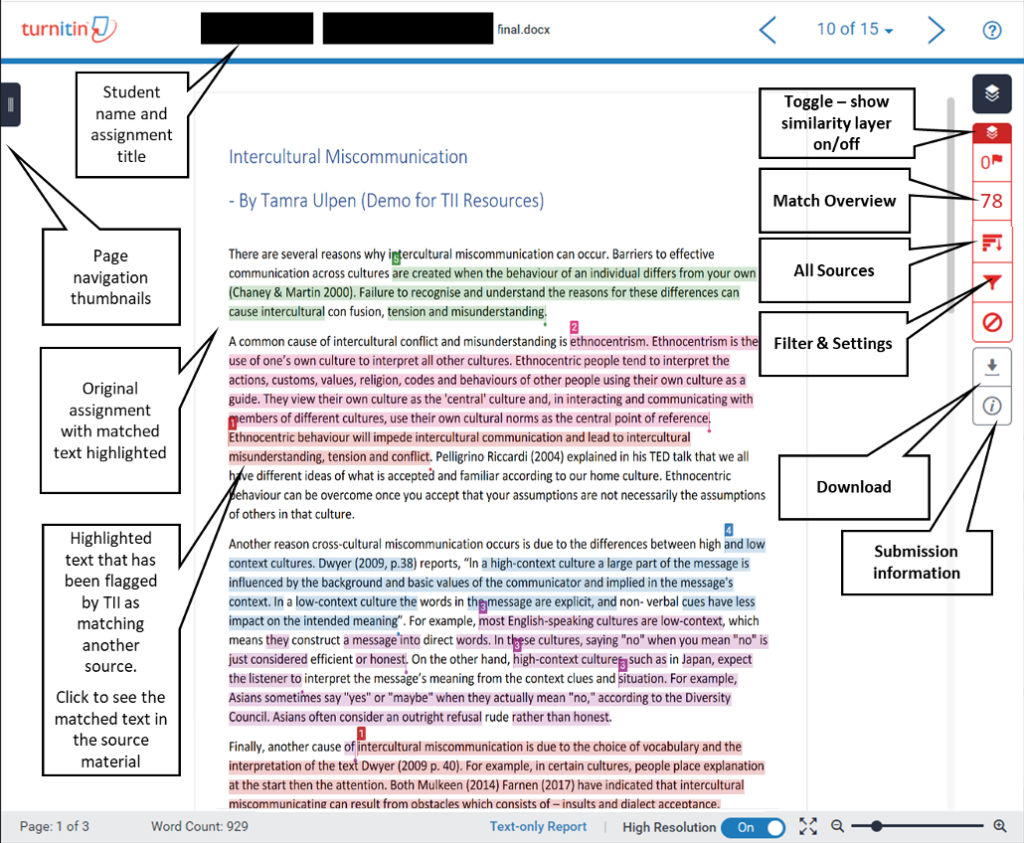
The first report checks similarity. It compares your text against billions of web pages, academic journals, and previously submitted student papers. It highlights matching text and spits out a similarity percentage. A 20% similarity score does not mean one-fifth of your paper is plagiarized. It means one-fifth of your text matches something in the database. That could be properly cited quotes, standard definitions, or common phrases in your field.
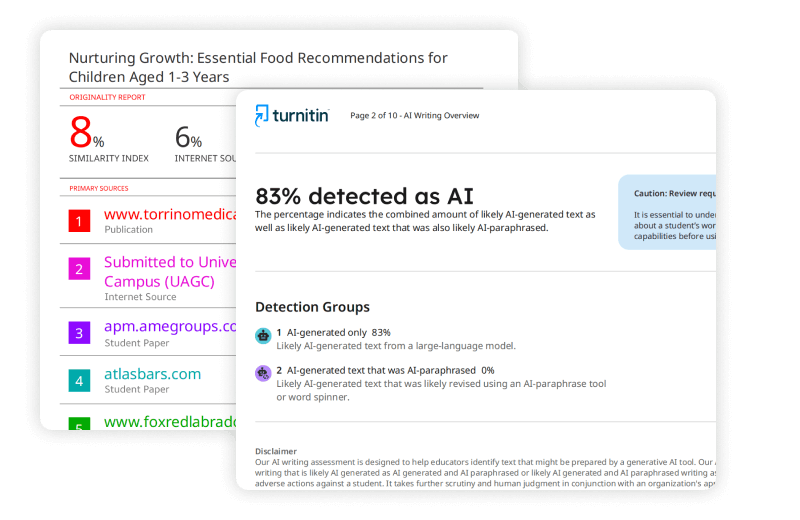
The second report checks for AI writing. This runs on completely different technology. It does not look for matching text at all. It looks for statistical patterns common in large language model output. These two scores are independent. You can score 0% on similarity and still get flagged for AI. You can have a 40% similarity score and zero AI detection.

Check before you submit. Get Turnitin Score Report in 15 Minutes.
Don't risk the 'Red' score. Get the exact same Turnitin report your supervisor uses. You will receive a full PDF similarity report including AI detection.
Your professor sees both numbers side by side, but they mean different things. Confusing them leads to bad decisions.
Segments, Not Sentences
Turnitin breaks your document into chunks of roughly 300 words each. If you submit a 3,000-word essay, the system creates about ten segments. It analyzes each segment individually for perplexity and burstiness.
Perplexity measures predictability. AI tends to choose the safest, most average next word in a sentence. Human writing surprises. We use odd word choices, sudden shifts in tone, and unexpected examples. If Turnitin can guess your next word easily, your perplexity drops. Low perplexity signals AI authorship.
Burstiness measures variation in sentence length and structure. AI output tends toward a steady rhythm. Sentences cluster around fifteen to twenty words. Humans write in bursts. A long, winding sentence crashes into a short one. A paragraph of complex analysis sits next to a simple observation.
Turnitin classifies each segment as human or AI, then calculates the percentage of segments flagged. This segment-based approach creates strange edge cases. A paper with 90% human writing and one AI paragraph might score 10% AI. A paper with mixed human and AI text throughout might score higher because many segments contain just enough AI patterns to trigger flags.
The Hidden Truth About Accuracy
Turnitin markets its tool as highly accurate, and in controlled conditions it performs reasonably well on obvious cases. Raw, unedited ChatGPT output gets caught around 85% of the time. But real student writing is never that clean. You edit. You rewrite. You add your own examples. The moment you intervene, the accuracy picture gets messy.
The 15% Blind Spot
Here is a detail Turnitin admits openly. To keep false accusations low, the system accepts missing up to 15% of AI-written text. If Turnitin reports that 50% of your document is AI-generated, the real figure could be 65%. The company deliberately tuned the model to favor human writers. Annie Chechitelli, Turnitin’s Chief Product Officer, has acknowledged this trade-off publicly.
That means the tool errs on the side of letting AI slip through rather than accusing innocent students. On paper, that sounds ethical. In practice, it means the score your professor sees is an underestimate, not a precise measurement. And if the system is designed to miss content, treating its output as definitive evidence makes no sense.
The 20% Asterisk
Scores below 20% come with a built-in warning. Turnitin displays an asterisk instead of a precise number in the low range because its own data shows higher false positive rates between 1% and 20%. The system is literally telling instructors, “We are less confident about this.”
Yet students panic over a 12% score. Professors sometimes treat any non-zero number as suspicious. The hidden truth is that Turnitin itself does not trust its own output in that range. If your professor cites a 15% AI score as evidence of misconduct, they are using a number the system explicitly flags as unreliable.
Who Gets Falsely Flagged
False positives are not random. They cluster around specific groups of writers.
A 2023 study from Stanford University, published in the journal Patterns, found that AI detectors classified over 61% of essays written by non-native English speakers as AI-generated. The reason is brutal but simple. Non-native writers often use simpler vocabulary and more formulaic sentence structures. Those patterns overlap with the statistical signatures of AI output. The detector cannot tell the difference between a student learning English and a machine generating text.
Other groups face similar risks. Students in highly structured disciplines like law or engineering write in standardized formats that look algorithmic. Neurodivergent writers may use repeated phrases or consistent structures that trigger flags. Even students who write very cleanly, with polished grammar and few errors, can get accused because flawless prose paradoxically resembles AI output.
At a university like Ohio State, with roughly 66,901 students, a 4% false positive rate means over 2,600 innocent students could face accusations. That is why Vanderbilt University discontinued its use of Turnitin AI detection. The risk of harming innocent students outweighed the benefits.
What Turnitin Cannot See
The system has hard limits that rarely get discussed in orientation sessions.
Non-Prose and Short Content
Turnitin’s AI model only analyzes long-form prose. It skips poetry, scripts, code, bullet-point lists, tables, and annotated bibliographies. Short responses under 300 words often get no meaningful analysis at all. If your assignment mixes formats, the AI percentage reflects only the prose portions. A low score might simply mean the system ignored half your submission.
Translated Text
As of early 2026, Turnitin supports only three languages for AI detection: English, Spanish, and Japanese. If you translate content from another language into English, the detector usually misses it entirely. The source text is not in the training data, so the translated version appears original. Of course, translation without attribution is still plagiarism. Turnitin just cannot catch it.
Visual Content
Turnitin analyzes text only. It cannot check images, charts, graphs, or infographics. If someone copies a chart from a research paper and pastes it into their submission, Turnitin stays silent. You still need to cite every visual element, but the system offers zero help on that front.
What the Numbers Actually Mean
Students obsess over percentages without understanding what generates them. Let us fix that.
Reading Your Turnitin Score Check
When you run a Turnitin score check, you get two numbers. The similarity percentage tells you how much text matches existing sources. The AI percentage tells you how much qualifying prose resembles AI-generated patterns. They do not add up to 100%. They do not correlate. A paper can score 5% similarity and 80% AI, or 45% similarity and 0% AI.
According to Turnitin’s February 2026 data release, approximately 15% of essay submissions now contain more than 80% AI-generated writing. That is up from roughly 3% when the detector launched in 2023. Universities are paying closer attention to both scores because the volume of AI submissions has exploded.
If you want to check your paper before final submission, you cannot use Turnitin directly as a student. The company sells to institutions, not individuals. Services like AnswersFountain.com offer Turnitin score check reports that show you exactly what your instructor will see, including both similarity and AI percentages, without adding your paper to the database. Running a preliminary check lets you fix citation issues and rewrite flagged sections before the deadline.
When Instructors Panic
A professor sees a 60% AI score and assumes the worst. But that number does not explain how the paper was written. Maybe the student used AI for brainstorming and wrote every sentence themselves. Maybe they ran their draft through Grammarly and the editing patterns triggered the detector. Maybe they are a non-native speaker whose natural writing style matches the model’s training data.
Turnitin flags content only when it reaches 98% certainty at the sentence level. That sounds rigorous, but it applies to individual sentences, not the whole paper. A document can contain a mix of correctly flagged AI sentences, falsely flagged human sentences, and missed AI sentences all in the same submission. A Temple University study found that Turnitin’s flagged sentences often had no relationship to the parts actually written by AI. The tool flagged human-written sentences as AI and missed genuinely AI-generated sections.
The same study tested hybrid texts, part human and part AI. Turnitin correctly identified only 43% of these mixed submissions as neither fully human nor fully AI. Six were labeled 100% AI. Seven were labeled 100% human. When the tool struggles this much with real-world writing, using it as primary evidence is indefensible.
Protecting Your Work
You cannot control Turnitin’s algorithm, but you can control your process.
First, keep your drafts. Save every outline, rough version, and set of notes. If you get flagged, evidence of your writing process is your best defense. Most universities have appeal mechanisms, and Turnitin itself states that instructors should make the final interpretation.
Second, vary your sentence structure intentionally. Write a long, complex sentence followed by a short punchy one. Add personal examples the AI would not know. Cite sources the model has no access to. Insert your own opinions and analytical quirks. The more your writing sounds like a specific human with a specific voice, the lower your AI probability drops.
Third, understand that editing AI output is not enough. The Temple study found that lightly edited AI text still triggered flags, while thoroughly rewritten content often slipped through. If you use AI tools, treat their output as a starting point, not a product. Restructure paragraphs, change every transition, and add your own reasoning chains.
Fourth, cite everything. Turnitin’s similarity checker catches direct copying from academic databases better than free alternatives. Proper citations protect you from plagiarism accusations even when the similarity score looks high.
The Bottom Line
Turnitin AI detection is not what you think. It is not a fingerprint scanner for ChatGPT. It is a pattern-matching tool with known blind spots, documented bias against certain writers, and a built-in margin of error that reaches 15%. The scores it produces are indicators, not verdicts. Your professor sees a number, but that number comes with caveats Turnitin itself publishes in its own documentation.
If you are worried about your next submission, run a preliminary Turnitin score check through a service that gives you the full report. Understand what the similarity and AI percentages actually measure. Write in your own voice, keep your drafts, and know your rights if you get falsely flagged. The tool is a safety net, not a trap, but only if you know where the holes are.
The hidden truth is simple. Turnitin guesses. Sometimes it guesses right. Sometimes it guesses wrong. Your job is to make your writing so distinctly human that no algorithm can mistake it for anything else.