
Can Turnitin be wrong? Real cases show false AI detection happens more than you’d think. Learn what to do if your human-written work gets flagged.
Can Turnitin Be Wrong? Here Is What the Data Actually Says
You ran a Turnitin check before your deadline. The similarity score looked fine, maybe 12% or 15%, well within range. Then you saw the AI detection percentage. Suddenly your professor gets an alert, and you are explaining yourself in an office you never planned to visit. This happens to real students, at real universities, with real consequences. The question is not whether Turnitin makes mistakes. It does. The better question is how often, why, and what you can do when a machine calls your work fake.
Turnitin’s AI detection tool launched in April 2023 and quickly spread across more than 16,000 institutions globally. The company markets it as a way to preserve academic integrity in an age of ChatGPT and Claude. Turnitin claims its system catches roughly 85% of unmodified AI-generated text while keeping document-level false positives below 1% for papers showing over 20% AI content. Those numbers sound reassuring until you realize what they leave out. At the sentence level, Turnitin admits its false positive rate sits closer to 4%. That means one in every 25 sentences flagged as AI might actually be yours. When you multiply that across a 3,000-word essay, the odds of a clean mistake start looking less like a rare glitch and more like a predictable flaw .
Real Cases of False AI Detection
The Johns Hopkins Professor Who Caught the Pattern
Taylor Hahn teaches communications at Johns Hopkins University. In the spring of 2023, he uploaded a student paper to Turnitin and watched the tool label more than 90% of it as AI-generated. Hahn met with the student over Zoom, expecting a difficult conversation. Instead, the student immediately shared drafts, PDFs with highlighted notes, and revision history. Hahn walked away convinced. Turnitin had made a mistake. But the problem did not stop there. Over that same semester, Hahn noticed a recurring pattern. International students faced false flags far more often than their native-speaking peers. Their writing tended toward simpler sentence structures and more predictable word choices, not because they used ChatGPT, but because they were writing in a second language. Turnitin’s algorithm read that restraint as machine precision .
When the Professor Writes With You
In another case at Johns Hopkins, Hahn worked directly with a student on an outline and multiple drafts. He saw the writing develop in real time. When the final paper submitted to Turnitin, the majority of it still lit up as AI-generated. Think about that for a moment. A professor co-created the assignment with a student, watched the human process unfold, and still the software cried foul. If a trained educator sitting beside the writer cannot prevent a false positive, what chance does a student working alone have?
The Vanderbilt Shutdown
Vanderbilt University did not just grumble about false positives. They acted. After testing Turnitin’s AI detector for several months and submitting roughly 75,000 papers annually through the platform, Vanderbilt publicly disabled the feature. Their math was simple. A 1% false positive rate across 75,000 submissions equals 750 students potentially accused of cheating based on a bad read. University leaders cited the risk of “loss of student trust, confidence and motivation, bad publicity, and potential legal sanctions.” They were not alone. The University of Pittsburgh also told faculty it did not support AI detectors, specifically because false positives damage student relationships and carry real institutional risk .
The International Student Bias
Stanford computer scientists ran a controlled experiment in 2023 to test whether AI detectors discriminate. They did not test Turnitin directly, but they tested seven similar tools. The results were disturbing. Non-native English writing triggered false AI flags 61% of the time. On roughly 20% of papers, every single detector agreed the human-written text was machine-made. The researchers explained the mechanism simply. Non-native speakers often use smaller vocabularies and simpler grammatical constructions in English. AI models trained on massive text corpora also default to common, predictable word patterns. The detectors learn to associate simplicity with machines, and in doing so, they punish students who already face language barriers .
Heewon Yang, a student at New York University who grew up in South Korea, put the frustration plainly. She told reporters she had no idea how to prevent the flagging because the detector seemed to target her natural language patterns automatically. This is not a user error. This is a design flaw baked into how these models learn.

Check before you submit. Get Turnitin Score Report in 15 Minutes.
Don't risk the 'Red' score. Get the exact same Turnitin report your supervisor uses. You will receive a full PDF similarity report including AI detection.
Why Turnitin Gets It Wrong
The Perplexity Trap
Turnitin’s AI detector does not scan for plagiarism in the traditional sense. It runs a completely separate analysis from the similarity report you already know. The AI tool uses a sentence-level classification model that measures two things primarily: perplexity and burstiness. Perplexity means how predictable your word choices are. Burstiness measures how much your sentence lengths vary. Human writers naturally mix short punchy statements with longer, winding ones. AI tends to produce uniform blocks of text, often landing in that 15-to-20-word comfort zone. When your writing is too clean, too consistent, or too grammatically correct, the model suspects automation .
Here is the catch. Good writing instruction teaches clarity, structure, and smooth transitions. Professors tell you to use topic sentences, logical flow, and consistent grammar. Those exact habits can push your perplexity score down and your uniformity up. In other words, following the rules of academic writing can make you look like a robot to Turnitin.
Grammar Tools and the False Positive Problem
Students who run their drafts through Grammarly or similar editing tools face another layer of risk. Turnitin states that basic spelling and grammar corrections do not trigger flags. However, Grammarly’s generative features, including rephrase, rewrite, and “best version” suggestions, can alter your text enough to match AI patterns. The same applies to heavy paraphrasing tools. If you paste AI-generated text into a paraphraser and swap synonyms, Turnitin often still catches it. But if you write something original and then over-edit it into polished, predictable prose, you might accidentally manufacture the exact signals the detector hunts .
The Washington Post Investigation
Geoffrey Fowler, a technology columnist at The Washington Post, tested Turnitin’s detector before its public launch using real student essays and AI-generated samples. Of the 16 submissions, Turnitin misidentified over half at least partially. One fully human-written essay came back flagged as partly AI-generated. Fowler later received emails from students and parents across the country describing false accusations that derailed semesters and damaged reputations. The stakes of even a 1% error rate become clear when you remember that behind every percentage point sits a real person facing an academic integrity investigation .
How Universities Are Changing Course
The response from higher education has shifted quickly. In 2023 and 2024, many schools rushed to adopt zero-tolerance AI policies and treated detector scores as evidence. By 2025 and 2026, that posture softened. Turnitin itself tells instructors that AI scores are indicators, not verdicts. Most institutions now set trigger thresholds between 15% and 40%, and even above those lines, professors are expected to apply judgment, review writing history, and consider assignment context .
Some schools have gone further. After disabling Turnitin’s AI detector, Vanderbilt directed faculty toward conversation-based approaches. Rather than treating a Turnitin score check as proof of misconduct, they encourage professors to ask students about their process, their sources, and their choices. This shift recognizes a hard truth that computer scientists at the University of Maryland have been vocal about. Soheil Feizi and his team published preprint research arguing that reliable AI detection may be mathematically impossible as language models improve. The distributions of human and AI text are converging, and no publicly available detector currently meets the standard of reliability needed for high-stakes decisions .
What You Can Do If Turnitin Flags Your Work
Document Everything
If you receive a false positive, your best defense is a paper trail. Save every draft, every outline, every set of research notes with timestamps. Screenshots of your writing process matter. If you use Google Docs, version history can show hours of organic development. One student at Johns Hopkins saved herself from an integrity investigation by pulling up highlighted PDFs and rough drafts within minutes of being accused. Professors who see a human process tend to trust their eyes over an algorithm .
Run a Pre-Check Before You Submit
Many institutions allow draft submissions through Turnitin before the final deadline. Use this feature. A Turnitin score check on a draft gives you time to adjust if something looks off. If your AI percentage spikes unexpectedly, review your sentence variety. Break up uniform paragraphs. Insert a short, direct statement among longer explanatory ones. Add a specific example from your own experience. These small rhythm shifts can alter how the model reads your text without forcing you to write badly .
Understand What the Numbers Mean
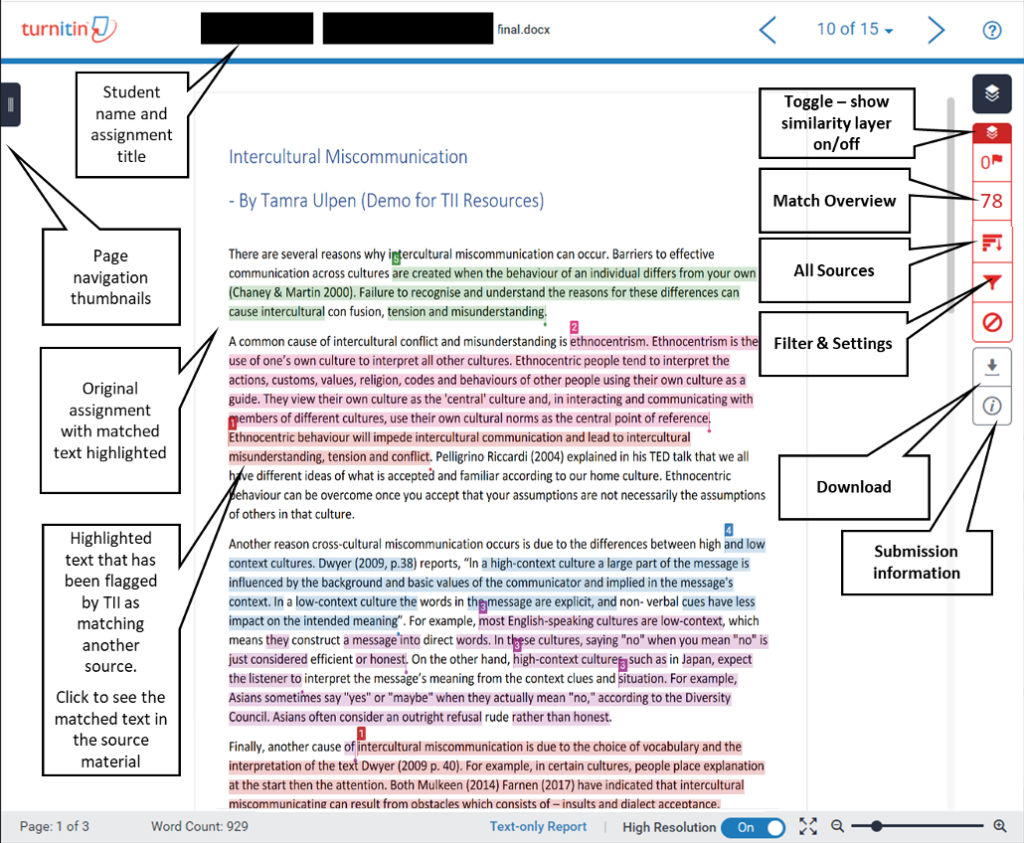
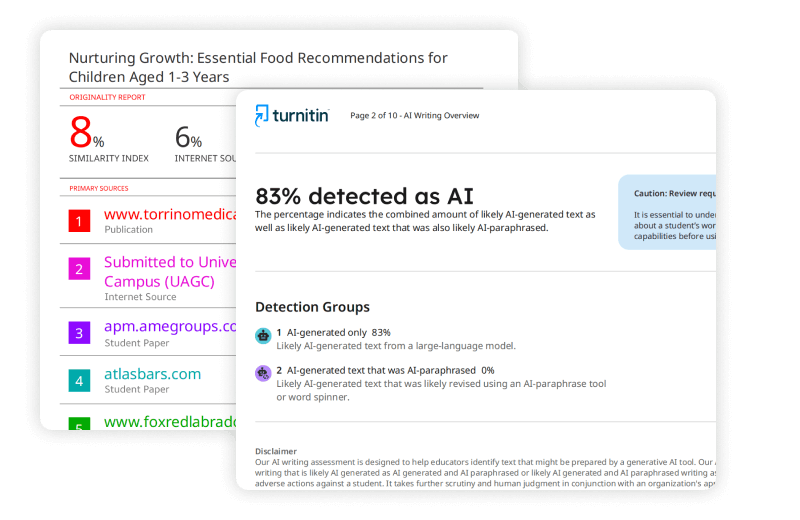
Turnitin’s AI detection report shows an overall percentage of sentences classified as likely AI-generated. For scores between 1% and 19%, the platform now displays an asterisk instead of a hard number, warning that results in this range are less reliable and more prone to false positives. If you see that asterisk, know that even Turnitin is telling your professor to take the number with a grain of salt .
The similarity report and the AI report operate independently. You can have 0% similarity and 80% AI detection, or high similarity with no AI flag at all. Understanding this separation helps you interpret your results accurately instead of panicking over a number that may not mean what you think.
Write With Rhythm and Specificity
You do not need to dumb down your writing to beat a detector. You need to humanize it. Use first-person reflections where appropriate. Cite specific lectures, conversations, or observations from your own life. Vary your sentence openings. Follow a complex sentence with a brief one. These patterns increase burstiness and reduce the mechanical uniformity that triggers flags. The goal is not to trick Turnitin. The goal is to make your text sound like you, because it is.
The Hard Truth About AI Detection
Turnitin remains a powerful tool for catching direct plagiarism and unmodified AI essays. When a student submits raw ChatGPT output without edits, the detector usually spots it. But the gap between “usually” and “always” matters. In independent testing, Turnitin correctly identified only 77% of fully AI-generated samples and 63% of disguised AI text. For hybrid documents, part human and part machine, accuracy dropped to 43%. Those are not edge cases. They represent the messy reality of how students actually write in 2026, with AI sometimes used for brainstorming, outlining, or early drafting before heavy human revision .
The technology is evolving, and Turnitin updates its models quarterly. Still, no update has eliminated the false positive problem. The company acknowledges it cannot mitigate the risk completely given the nature of AI writing analysis. That honesty is useful, but it does not help the student staring at a 90% AI flag on a paper they wrote alone at 2 a.m.
Your Next Move
So can Turnitin be wrong? Absolutely. Real cases at Johns Hopkins, Vanderbilt, NYU, and dozens of other schools prove it. The tool confuses clean human writing with machine output. It biases against non-native speakers. It misreads heavily edited drafts. And even its own creators admit the sentence-level error rate sits at 4%, with higher uncertainty below the 20% threshold.
If you are staring at a suspicious Turnitin check result, do not panic. Gather your drafts. Talk to your professor. Explain your process. Treat the detector as a starting point for conversation, not a final judgment. Universities increasingly recognize that these tools are imperfect, and many have adjusted their policies to match that reality.
For your own peace of mind, run a Turnitin score check early if your school allows draft submissions. Write with varied rhythm. Keep your notes. And remember that no algorithm knows your voice better than you do. In a landscape where machines grade machines, your humanity is still your best defense. Use it.
Keywords: Turnitin check, Turnitin score check, false AI detection, AI detection, Turnitin AI detection, Turnitin report, academic integrity, AI writing detection, Turnitin similarity report, AI percentage, detector flags, human writing vs AI, Turnitin false positives, pre-check submission, AI detection accuracy.