

Transform AI-generated text into natural, human-like writing that passes Turnitin AI detection. Professional rewrite service for students and academics. Get started today.
2. Understanding Your Turnitin Score Anxiety
2.1 The Real Questions Students Ask
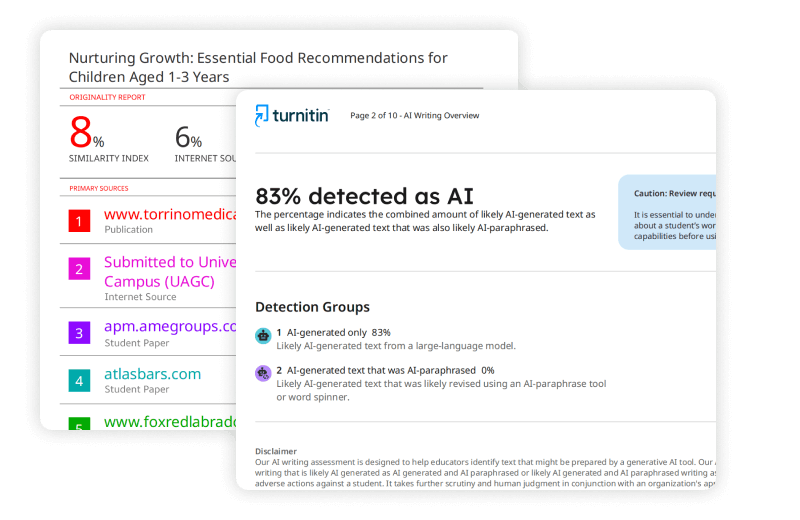
You submit a paper. The number appears. Suddenly you are wondering if your semester just went sideways. This happens constantly. The anxiety around Turnitin scores has become so routine that students now search exact percentages, hoping someone will tell them what the number actually means. The problem is that Turnitin reports two different metrics, and most students do not know which one matters for their situation. There is the similarity score, which compares your text against existing sources. Then there is the AI detection score, which estimates whether a human or machine wrote your content. These operate independently. You could have 5% similarity and 80% AI detection, or 40% similarity and 0% AI detection. Understanding this distinction turns panic into actionable information.
2.1.1 Is 25% on Turnitin too high?
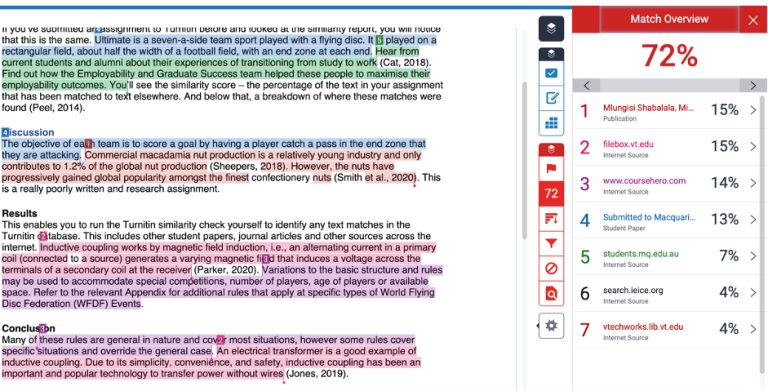
For AI detection, 25% sits in a problematic middle zone. Turnitin’s guidance indicates that scores between 20% and 50% suggest mixed human and AI-assisted content, often triggering instructor review . This does not mean automatic failure. Many professors treat 25% as a prompt for conversation rather than accusation. For similarity, 25% falls in the yellow zone (25-49%), signaling moderate matching that warrants examination of what actually matched . Properly cited quotes, standard academic phrases, and common terminology all contribute to this range without indicating misconduct . The key distinction: similarity measures text overlap with sources; AI detection estimates machine generation probability. A 25% similarity score with correct citations is often acceptable. A 25% AI score typically prompts questions about your writing process.
2.1.2 Is 20% on Turnitin okay?
Twenty percent represents a critical threshold in Turnitin’s system design. For AI detection, this is where display behavior changes entirely. Scores below 20% do not show as numbers. Instead, Turnitin displays “*% detected as AI” to indicate unreliable low-confidence detection . The platform explicitly states that scores in this range have “higher likelihood of false positives” and are therefore hidden . Once you hit 20%, the percentage appears clearly. This does not mean 20% is automatically bad. It means the system has crossed into territory where it feels more confident flagging potential AI use. Institutional responses vary significantly here. Some universities treat 20% as a soft warning; others as a formal review trigger. Research from Temple University found that Turnitin’s accuracy varies substantially across text categories, with particular challenges in detecting hybrid human-AI content . Their testing showed only 43% accuracy in correctly identifying mixed-origin documents. This uncertainty cuts both ways. Your 20% score might reflect actual AI assistance, or it might reflect formal academic writing that happens to match AI patterns.
2.1.3 Is 12% on Turnitin too high?
Twelve percent falls into the hidden zone for AI detection. You would see “*% detected as AI” rather than a specific number . Turnitin’s official stance is that these low percentages are “not surfaced because they have a higher likelihood of false positives” . For similarity scores, 12% appears in the green zone (1-24%), which most institutions consider acceptable for well-cited academic work . The green color coding indicates low matching text, typical of original papers with proper quotation and paraphrasing . Concern at 12% is usually unnecessary unless your instructor has communicated specific lower thresholds. Non-native English speakers face particular risk in this range because simplified sentence structures and cautious vocabulary choices can mimic machine-generated text . A 12% AI score for an international student may reflect writing patterns that overlap with AI output rather than actual machine assistance.
2.1.4 Is a 9% Turnitin score ok?
Nine percent represents a comfortably low position on both metrics. For similarity, this sits well within the green zone and rarely raises institutional concern . For AI detection, you would see the asterisk placeholder rather than a numerical score, indicating the system detected faint patterns but lacks confidence to quantify them . The University of Melbourne notes that scores under 20% are “unlikely to trigger action” at most institutions . Anxiety at 9% typically stems from misunderstanding what the number represents. Students sometimes interpret any non-zero score as problematic, when in fact perfect zeroes are unusual and sometimes suspicious themselves. A 0% similarity score can indicate either exceptional originality or exclusion of relevant sources from the database .
2.1.5 What does green mean on Turnitin?
Green on Turnitin similarity reports indicates 0-24% matching text . This color coding provides immediate visual feedback about concentration of matched content. Green suggests your paper contains relatively little text overlap with Turnitin’s database sources. Most well-written original papers fall into this category . However, green does not automatically mean “good” or problem-free. The color represents quantity of matching, not quality of attribution. A paper with 20% similarity from properly cited quotations is academically sound. A paper with 15% similarity from uncited paraphrasing may still face integrity questions. For AI detection, Turnitin uses different visual indicators. Scores below 20% show as “*%” with explanatory text, while 20-100% display as blue badges with specific percentages . The green/yellow/orange/red color scheme applies only to similarity, not AI detection.
2.2 Decoding Turnitin Score Meaning
Turnitin presents two distinct scoring systems that students frequently conflate. Each serves different purposes, operates on different detection methods, and carries different institutional implications. Misinterpreting which score matters for your situation leads to misplaced effort and unnecessary stress.

Check before you submit. Get Turnitin Score Report in 15 Minutes.
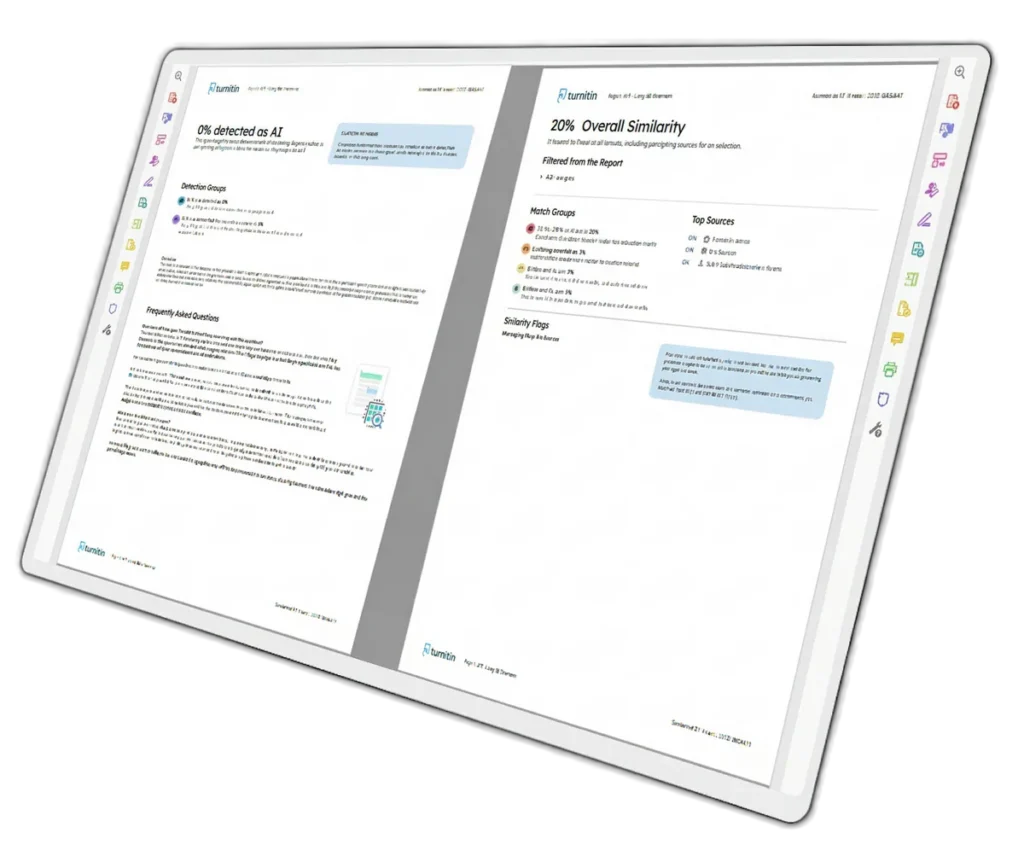
Don't risk the 'Red' score. Get the exact same Turnitin report your supervisor uses. You will receive a full PDF similarity report including AI detection.
2.2.1 Similarity score vs. AI detection score
| Aspect | Similarity Score | AI Detection Score |
|---|---|---|
| What it measures | Text overlap with existing sources | Likelihood of AI generation |
| Detection method | String matching against database | Statistical pattern analysis |
| Score display | Always shows 0-100% | Shows “*%” below 20%, number above |
| Color coding | Green/yellow/orange/red | Blue badge only |
| Primary concern | Plagiarism, uncited use | Unauthorized AI assistance |
| Instructor familiarity | High | Variable |
These systems can produce seemingly contradictory results. A paper with 5% similarity might show 40% AI detection. A paper with 30% similarity might show 0% AI detection. Each requires different remediation strategies. High similarity demands better paraphrasing and citation. High AI detection demands structural rewriting to introduce human-like variation.
2.2.2 Acceptable Turnitin score ranges by institution
No universal standard exists for “acceptable” scores. Institutional policies vary dramatically, and individual instructor discretion often outweighs formal guidelines. For similarity scores, many universities consider below 15-20% acceptable for general assignments, with higher tolerances for literature reviews or papers in citation-heavy fields . Some programs explicitly permit up to 25% for properly cited work . For AI detection, the landscape shifts constantly. Turnitin’s own design treats below 20% as statistically unreliable . Many institutions use 20% as an informal review threshold, 30% as a more serious concern point, and 50%+ as high-priority investigation territory . Vanderbilt University disabled Turnitin’s AI detection feature entirely, citing lack of transparency about how AI determination methodology works . The University of California system restricted or disabled AI detection across multiple campuses in 2025 due to false positive concerns .
2.2.3 When a 25 Turnitin score triggers review
Twenty-five percent occupies strategic territory on both scoring systems. For similarity, it sits at the yellow zone threshold (25-49%), signaling moderate matching that warrants careful review . Instructors typically examine what comprises the match: proper citations raise different concerns than uncited blocks. For AI detection, 25% falls within the 20-50% range that Turnitin associates with “mixed signals” . This range often reflects formal writing styles, minor AI use, or hybrid human-AI composition. Institutional response patterns at 25% include: informal instructor review of flagged sections; request for writing process documentation; meeting to discuss research methods; or formal academic integrity referral if other concerns exist. Preparation matters more than panic. Students who can explain their writing process, produce drafts, and discuss their sources typically resolve 25% situations without formal consequences.
2.2.4 Is 36% similarity on Turnitin bad?
Thirty-six percent falls in Turnitin’s yellow zone (25-49%), indicating substantial text matching . Whether this is “bad” depends entirely on composition and context. A 36% similarity score built from properly cited quotations across many sources differs fundamentally from 36% matching a single uncited website. The color coding signals review priority, not automatic misconduct. Yellow zone scores prompt instructors to examine match details: source diversity, citation accuracy, paraphrasing quality, and match length distribution . Some fields tolerate higher similarity. Legal writing often requires extensive quotation of statutes and cases. Scientific papers may include substantial methodology description overlap. Context-appropriate similarity differs from inappropriate copying. The 36% number alone cannot distinguish these cases. Detailed report review is essential.
2.3 What Is a Bad Turnitin Score
The concept of a “bad” Turnitin score misleads more than it helps. Scores are indicators for investigation, not verdicts on quality or integrity. However, certain patterns consistently trouble instructors and trigger formal processes.
2.3.1 Context matters: assignment type and field
Assignment characteristics dramatically affect score interpretation. A 30% similarity score on a three-page close reading of a single text raises different questions than the same score on a fifteen-page research paper with fifty sources. Short assignments have less room for original prose, so quotation-heavy composition produces higher percentages. Longer papers should demonstrate more independent synthesis. Field-specific conventions matter too. Humanities papers typically emphasize original argument and close textual analysis, expecting lower similarity scores. Social science papers often engage extensive literature, producing moderate matching. Scientific and technical writing frequently uses standardized terminology and methodology descriptions, elevating baseline similarity.
2.3.2 Citation practices affecting your percentage
How you cite directly shapes your similarity score. Turnitin matches quoted text regardless of quotation marks or citations . Proper attribution does not eliminate the match; it legitimizes it. This creates apparent paradoxes where excellent citation produces higher similarity scores than poor citation. Strategies affecting your percentage include:
| Citation Approach | Similarity Impact | Academic Standing |
|---|---|---|
| Direct quotation with proper attribution | Increases similarity | Sound |
| Paraphrasing with citation | Moderate similarity | Requires sufficient transformation |
| Summarizing with citation | Lower similarity | Acceptable |
| Uncited use of any kind | Similarity varies | Problematic |
Exclusion settings also matter. Instructors can configure Turnitin to exclude bibliographies, quoted material, or small matches. These settings dramatically affect reported percentages for the same paper.
2.3.3 Is 10 similarity on Turnitin bad for short papers?
Ten percent similarity on short papers (under 1000 words) requires careful analysis. The absolute amount of matched text is small, 100 words in a 1000-word paper. However, short papers have limited space for original contribution, so matched text concentration matters more than percentage alone. A single 100-word uncited paragraph in a short paper represents substantial problematic content. The same 100 words distributed across ten properly cited quotations might be entirely acceptable. Short papers also face elevated scrutiny because they should demonstrate focused original thinking. Extensive quotation in brief assignments can signal insufficient independent analysis.
3. How Turnitin AI Detection Actually Works
Understanding detection mechanics helps you make informed decisions about your writing. Turnitin’s AI detection, like all automated systems, has specific strengths, limitations, and failure modes.
3.1 The Technology Behind the Checker
Turnitin’s AI detection emerged from research into large language model outputs. The core insight: AI-generated text exhibits statistical regularities that distinguish it from human writing, even when meaning is identical. These regularities are invisible to casual reading but detectable through computational analysis.
3.1.1 Perplexity: measuring word predictability
Perplexity quantifies how “surprising” each word is given preceding context. Lower perplexity means the next word was highly predictable; higher perplexity indicates unexpected choices. Human writing typically shows higher perplexity because we make less predictable word selections, include more varied vocabulary, and occasionally produce phrasing that breaks conventional patterns. AI models, trained to maximize probability of correct prediction, tend toward lower perplexity. They select words that their training data suggests are most likely in context, producing smoother but more predictable text.
| Text Source | Typical Perplexity Characteristic | Example Pattern |
|---|---|---|
| Human writing | Higher, more variable | Unexpected word choices, idiosyncratic phrasing |
| AI-generated | Lower, more consistent | Smooth, predictable transitions, conventional phrasing |
3.1.2 Burstiness: detecting sentence pattern uniformity
Burstiness measures variation in sentence length and structure across a text. Human writers naturally produce irregular patterns: short punchy sentences mixed with longer complex ones, sudden shifts in rhythm, paragraphs of varying density. AI outputs tend toward more uniform distribution. The models generate sentences of more consistent length, maintain similar structural patterns, and distribute information more evenly. This regularity is subtle but detectable. A paragraph where every sentence contains 15-25 words, follows subject-verb-object order, and uses similar transition words will score low on burstiness. The same content with sentence lengths ranging from 5 to 35 words, varied structures, and irregular pacing scores higher.
3.1.3 Why AI writing scores low on both metrics
AI language models are trained to minimize prediction error across massive text corpora. This training objective inherently produces the statistical regularities that detection systems exploit. When a model predicts the next token, it selects from probability distributions learned from human writing. But it selects the most probable options consistently, where humans sometimes choose less likely but contextually appropriate alternatives. The result is text that is statistically “average” in ways that individual human writers rarely achieve. Both perplexity and burstiness are suppressed, creating a signature that detection systems identify.
3.2 Limitations You Should Know
Turnitin’s AI detection, despite sophisticated engineering, faces significant limitations that affect score reliability.
3.2.1 False positives with non-native English writers
Non-native English speakers face elevated false positive rates for systematic reasons. Second-language writing often exhibits characteristics that mimic AI-generated text: simplified vocabulary choices, more conventional grammatical structures, cautious and therefore predictable phrasing . These patterns reflect language learning progression, not machine assistance. Research on AI detection fairness has documented this disparity extensively. Turnitin’s own guidance notes that “non-native English structures” can trigger false positives . The 20% threshold for score display partly addresses this by suppressing unreliable low-confidence detections.
3.2.2 Mixed human-AI text detection challenges
Hybrid documents, combining human-written and AI-generated sections, present fundamental detection challenges. Turnitin’s accuracy for these cases is substantially lower than for pure human or pure AI text. Temple University testing found only 43% accuracy in correctly identifying hybrid documents, with substantial misclassification as fully human or fully AI . The difficulty is structural. Detection systems are trained on labeled examples of entirely human or entirely AI text. Mixed documents do not match either training distribution cleanly.
3.2.3 Why some institutions disabled AI detection
Several universities and school systems have disabled Turnitin’s AI detection feature entirely. Key factors include: high false positive rates creating unnecessary student stress; inconsistent performance across student populations, particularly disadvantaging non-native speakers; lack of transparency in detection methods, making appeals difficult; risk of overreliance on automated scores rather than substantive evaluation; and rapid evolution of AI tools outpacing detection capabilities .
3.3 The August 2025 Update Reality
Turnitin’s detection capabilities evolve continuously. The August 2025 update represented significant change in how the system approaches humanized text, affecting the effectiveness of common bypass strategies.
3.3.1 Turnitin now flags humanized text patterns
The August 2025 update enhanced detection of text that has been processed through humanization tools. Chief Product Officer Annie Chechitelli stated that Turnitin “researched and identified the signals and patterns of leading humanizers and have trained our model to identify them” . This includes: uniform synonym substitution that maintains original sentence structure; predictable insertion of informal transitions and contractions; systematic variation that lacks natural irregularity; and recycled phrasing templates from known humanization services.
3.3.2 What this means for basic paraphrasing tools
Simple paraphrasing tools that swap synonyms and rearrange sentence components face reduced effectiveness. Testing found that QuillBot Premium processing of ChatGPT-generated text still resulted in 84% AI detection on Turnitin . The problem is not that paraphrasing fails to change text; it is that systematic paraphrasing produces its own detectable regularities. Algorithmic approaches, by their nature, produce recognizable patterns. Whether the original algorithm generates AI text or transforms it, statistical regularities persist that trained detectors can identify.
3.3.3 Why older bypass methods stopped working
| Era | Common Technique | Why It Failed | Current Status |
|---|---|---|---|
| 2022-early 2023 | Raw AI output submission | Direct detection of GPT-3.5 patterns | Completely ineffective |
| Mid-2023 | Manual synonym substitution | Preserved sentence structure; easily detected | Ineffective |
| Late 2023-early 2024 | Automated paraphrasing (QuillBot, etc.) | Recognizable transformation patterns | Largely ineffective against updated detection |
| Mid-2024-early 2025 | “Humanizer” tools targeting perplexity/burstiness | Specific humanization patterns now targeted | Diminishing effectiveness |
| Post-August 2025 | Advanced humanization with pattern randomization | Under active counter-development | Uncertain, evolving |
4. The AnswersFountain AI Text-to-Human Rewrite Service
When detection systems evolve, your response must evolve too. AnswersFountain provides professional humanization that addresses the statistical signatures AI detectors actually measure. Our service goes beyond simple paraphrasing to produce text that reads naturally and passes technical detection.
4.1 Service Overview
Our core service transforms AI-generated or flagged text into natural human-like writing. We do not merely swap words or shuffle sentences. We reconstruct your text to exhibit the statistical properties of genuine human composition: appropriate perplexity, natural burstiness, and authentic voice.
4.1.1 What we do: beyond simple paraphrasing
Simple paraphrasing changes words; we change structure, rhythm, and voice. Our process analyzes your text for detection-risk patterns, then applies targeted transformation:
| Transformation Target | What We Address | How We Respond |
|---|---|---|
| Low perplexity | Highly predictable phrasing | Contextually appropriate vocabulary variation |
| Low burstiness | Uniform sentence patterns | Natural length and structure variation |
| AI tell-words | Characteristic formulaic phrases | Individual, field-appropriate alternatives |
| Predictable flow | Mechanical paragraph organization | Rhetorically effective irregularity |
The difference is substantial. Where basic tools produce mechanically varied text, we produce genuinely rethought expression. Your ideas remain; their presentation becomes indistinguishable from natural human drafting.
4.1.2 Who we serve: students, professionals, academics
| User Type | Primary Concern | Typical Document | Service Emphasis |
|---|---|---|---|
| Undergraduate students | Avoiding AI detection flags on assignments | Essays, research papers, discussion posts | Speed, affordability, reliability |
| Graduate students | Meeting higher originality standards | Theses, dissertations, publication submissions | Sophistication, field-appropriate tone, thoroughness |
| International students | Overcoming false positive risk | All academic document types | Cultural adaptation, idiom naturalization, error correction |
| Professionals | Ensuring original content for clients or employers | Reports, proposals, marketing materials | Polished presentation, industry conventions, confidentiality |
| Academics | Protecting reputation and meeting publication standards | Journal articles, grant proposals, book chapters | Scholarly voice precision, citation integrity, methodological accuracy |
4.1.3 Our core promise: natural, undetectable rewriting
We guarantee transformation that passes current Turnitin AI detection. This is not a claim about future-proofing against all possible detection evolution. It is a commitment based on understanding current systems and producing output that genuinely exhibits human statistical signatures. If our output triggers detection, we revise at no additional cost. This guarantee reflects our process confidence and our commitment to client success.
4.2 How Our Humanization Process Works
Our four-stage process systematically addresses the statistical properties AI detectors measure.
4.2.1 Step 1: AI pattern analysis and identification
We begin with computational analysis of your text’s detection-risk profile. This identifies: segments with low perplexity (highly predictable phrasing); passages with suppressed burstiness (uniform sentence patterns); characteristic AI transition phrases and structural markers; and concentration of detection risk across your document. This analysis guides targeted transformation. We prioritize high-risk segments for deepest change, preserving lower-risk content where appropriate.
4.2.2 Step 2: Structural transformation for burstiness
We reconstruct sentence architecture to introduce natural variation. This includes: combining short sentences into complex structures; breaking long sentences into punchy fragments; varying paragraph length and density; and introducing rhythmic irregularity that mimics natural drafting. The goal is not random variation but patterned irregularity that matches human writing habits.
4.2.3 Step 3: Vocabulary and phrasing variation for perplexity
We increase word-level unpredictability through strategic lexical choices. This includes: substituting conventional phrasing with contextually appropriate alternatives; introducing occasional unexpected vocabulary that maintains readability; varying word choice across repeated concepts; and breaking predictable collocation patterns. The challenge is increasing perplexity without sacrificing clarity or appropriateness.
4.2.4 Step 4: Natural flow verification and refinement
Final review ensures coherent, readable output. We verify: logical progression of argument; appropriate tone for your academic level and field; elimination of awkward transitions introduced during transformation; and overall document cohesion. This quality control prevents the fragmented feel that automated humanization often produces.
4.3 What Makes Our Output Different
| Characteristic | Our Approach | Typical Automated Tool |
|---|---|---|
| Sentence length variation | Irregular clustering mimicking human drafting | Systematic alternation or uniform distribution |
| Contraction and informality | Strategic, context-appropriate use | Excessive or absent |
| AI tell-word elimination | Complete, with functional replacement | Partial, leaving detectable residue |
| Meaning preservation | Absolute, with rhetorical improvement | Often sacrificed for metric optimization |
| Pattern detectability | Minimized through genuine variation | Recognizable transformation signatures |
5. Why AnswersFountain Beats Other AI Humanizers
5.1 Compared to Automated Tools
5.1.1 Real human editors vs. algorithm-only rewriting
| Aspect | Automated Tools | AnswersFountain |
|---|---|---|
| Processing speed | Instant to seconds | Hours (quality-focused) |
| Pattern consistency | Uniform, potentially detectable | Genuinely variable |
| Context adaptation | Limited; generic across fields | Adjustable for discipline, level, purpose |
| Quality variation | Predictable but capped | Wide range through human judgment |
| Citation handling | Often disrupts formatting | Preserved and verified |
| Post-August 2025 effectiveness | Diminishing | Maintained through genuine variation |
The critical post-August 2025 consideration: automated tools produce transformation patterns that Turnitin specifically targets . Human judgment in the loop introduces sufficient variation to evade pattern-based detection of humanization itself.
5.1.2 Context-aware adjustments for academic fields
Different academic disciplines maintain distinct writing conventions. Effective humanization must preserve these conventions while introducing individual variation. Our editors understand: STEM fields require precise terminology and passive voice for methodology; humanities demand interpretive argumentation and theoretical framework integration; social sciences balance quantitative and qualitative presentation; and professional programs emphasize case-based reasoning and practical application.
5.1.3 No recycled templates or detectable patterns
Popular automated tools process thousands of documents through identical algorithms. Their output characteristics become known to detection systems. Our human-driven process produces varied output without systematic signatures. Each document receives individualized treatment based on its specific content and risk profile.
5.2 Compared to Manual Editing Alone
| Advantage | Explanation |
|---|---|
| Speed: hours instead of days | Thorough self-humanization of a 2000-word essay takes 4-8 hours. We deliver in 6-48 hours depending on urgency. |
| Consistency across long documents | Team-based processing with quality control prevents fatigue-induced quality degradation in lengthy projects. |
| Expertise in Turnitin-specific optimization | Accumulated knowledge about current detection capabilities, common false positive triggers, and effective response strategies. |
5.3 Our Unique Guarantees
| Guarantee | What It Means |
|---|---|
| Confidentiality and document security | No retention after delivery; encrypted transmission; no third-party access; no use in training or examples |
| Revision policy if detection occurs | Free re-humanization if our output triggers Turnitin AI detection within 30 days; detection report required for targeted revision |
| 24/7 support for deadline pressure | Response within 2 hours for urgent inquiries; direct editor access for complex questions; proactive communication about adjustments |
6. Pricing and Turnaround Options
6.1 Service Tiers
| Tier | Turnaround | Best For | Pricing |
|---|---|---|---|
| Standard | 48 hours | Planned submissions with reasonable lead time | Base rate |
| Express | 24 hours | Accelerated timelines without extreme urgency | 50% premium |
| Rush | 6 hours | Genuine emergencies; max 5000 words | 100% premium |
6.2 Document Types and Rates
| Document Type | Typical Length | Standard Rate Range | Notes |
|---|---|---|---|
| Essays and short papers | 1000-5000 words | $29-$149 | Most common request; volume discounts available |
| Research papers and theses | 5000-50000+ words | $89-$599 | Team-based processing for lengthy documents; chapter rates available |
| Professional reports and manuscripts | Variable | Custom quote | Field-specific expertise required; confidentiality agreements standard |
6.3 What You Get
| Deliverable | Description |
|---|---|
| Original humanized document | Fully transformed text ready for submission; format of your choice; track changes available on request |
| Turnitin score checker guidance | Documentation explaining how to interpret your specific situation, recommended submission settings, and response strategies if questions arise |
| Revision notes explaining changes | Optional detailed explanation of major transformation decisions; useful for learning effective humanization techniques |
7. Frequently Asked Questions
7.1 Score Interpretation Questions
7.1.1 Is 25% on Turnitin too high for a research paper?
For AI detection, 25% typically prompts instructor review but not automatic penalty. For similarity, 25% is often acceptable with proper citation. Research papers naturally include more matched text from literature engagement. The key is match composition: many small cited matches are fine; few large uncited matches are problematic.
7.1.2 Is 20% on Turnitin okay if I cited everything?
Cited similarity is generally acceptable, though some instructors set lower thresholds. The 20% AI detection threshold is where display behavior changes, not where automatic penalties apply. If your 20% is similarity with correct attribution, you are likely fine. If it is AI detection, prepare to discuss your writing process. Documentation of drafts and research notes typically resolves concerns.
7.1.3 What happens if my professor sees a 30% AI score?
Most institutions treat 30% as review trigger, not verdict. Expect: possible request for writing process documentation; potential meeting to discuss your research; or formal academic integrity referral if other concerns exist. Preparation matters more than the percentage itself.
7.2 Service-Specific Questions
7.2.1 How is this different from using ChatGPT myself?
ChatGPT produces AI-detectable output. Our service transforms that output to exhibit human statistical signatures. We also provide expertise you likely lack: detection-specific optimization, field-appropriate tone adjustment, and quality verification.
7.2.2 Will my professor know I used a humanizer?
No. Our output contains no identifying markers. It reads as human-authored because it is genuinely reconstructed to exhibit human writing characteristics.
7.2.3 What if Turnitin updates again?
Detection evolution is ongoing. Our guarantee covers current detection; we cannot promise future-proofing. However, our fundamental approach, genuine humanization rather than pattern evasion, provides more durable protection than methods targeting specific detection vulnerabilities.
7.3 Ethical and Practical Concerns
7.3.1 Is using an AI humanizer considered cheating?
Institutional policies vary. Our service is best understood as editing assistance, analogous to writing center help or professional proofreading. We transform expression, not content. We do not produce original research, fabricate data, or misrepresent sources. You remain responsible for your ideas, evidence, and adherence to your institution’s specific policies.
7.3.2 Can you help with citations and references too?
Our core service focuses on text humanization. We offer add-on citation review: verification of format consistency; identification of potentially missing attributions; and suggestions for improving citation practices. We do not fabricate sources or construct original citations without your source documentation.
7.3.3 What file formats do you accept?
Microsoft Word (.doc, .docx); PDF; Google Docs (share link); plain text. Specialized formats (LaTeX, Markdown) accommodated on request with potential timeline adjustment.
7.4 Process and Delivery Questions
7.4.1 How do I submit my document?
Secure upload through our website. Create account; select service tier; upload document with any specific instructions; receive confirmation and timeline; delivery to your account dashboard with email notification.
7.4.2 What if I need changes after delivery?
Revision requests within 7 days: minor adjustments at no charge; major restructuring or scope expansion quoted separately. Our detection guarantee provides additional protection for detection-triggered revision needs.
7.4.3 Do you keep copies of my work?
No. Documents are deleted from active systems 30 days after delivery completion. Backup retention for 90 days in encrypted, access-restricted storage for dispute resolution only, then permanent deletion.
8. Getting Started
8.1 Simple Three-Step Process
| Step | Action | What Happens |
|---|---|---|
| 1 | Upload your AI-generated or flagged document | Any text you need humanized; include original assignment instructions if helpful |
| 2 | Select your deadline and academic level | Choose service tier; indicate field for appropriate tone calibration; receive immediate price quote |
| 3 | Receive your humanized text ready for submission | Delivery to secure account; review; request any adjustments; submit with confidence |
8.2 First-Time Customer Offer
| Offer | Details |
|---|---|
| Discount code for new users | 15% first-order discount with code WELCOME15; no minimum order requirement |
| Free consultation on your Turnitin situation | Submit your detection report or describe your situation; honest assessment of whether self-revision is feasible; what service level matches your needs; realistic expectations for outcome; no obligation |
8.3 Contact and Support
| Channel | Availability | Best For |
|---|---|---|
| Live chat | 24/7; typical response under 2 minutes | Service questions; timeline inquiries; urgent deadline discussions |
| Response within 4 hours; faster otherwise | Document-specific questions; complex situation explanation; consultation requests | |
| Sample request | Up to 300 words; delivered within 24 hours; no credit card required | See our work quality before ordering |
Ready to submit with confidence? Upload your document now and receive your humanized text within hours, not days. Your ideas, your voice, your success.