

Learn how to access Turnitin reports, understand AI detection, and compare plagiarism checkers. Complete 2026 guide for students, educators, and institutions.
Buy Turnitin Report: Complete Guide to AI and Plagiarism Checking
Understanding Turnitin Reports and Their Value
What a Turnitin Report Actually Contains
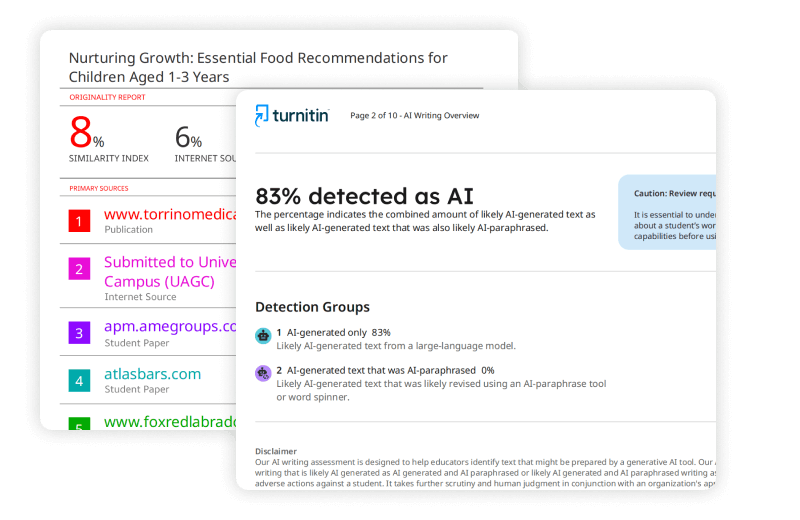
A Turnitin report delivers one of the most comprehensive academic integrity assessments available today. When you generate a Turnitin report, you receive a multi-layered analysis examining your document against over 91 billion web pages, 1.7 billion student papers, and extensive academic publications . The core output is the similarity percentage, which measures how much of your text matches content in Turnitin’s databases. This number alone, however, tells only part of the story. A 15% similarity score might indicate properly cited quotations, while 5% could hide serious uncited copying. The full report breaks down matches by source type, showing exactly where overlaps occur and enabling informed judgment about their significance.
The AI detection component, introduced in 2023 and enhanced through 2024-2025, adds another dimension. This feature generates an AI writing indicator estimating the proportion of text likely generated by large language models such as GPT-4, Claude, Gemini, and LLaMA . The system segments submissions into chunks of approximately 300 words minimum, analyzing each for statistical patterns characteristic of machine output. However, GPT-5 and newer models may evade detection, creating an ongoing technological arms race . The AI report highlights specific flagged segments, enabling targeted review rather than blanket judgments about entire documents.
Source matching provides granular detail through color-coded highlighting. Internet sources, publications, and student papers each receive distinct colors, with direct links to original materials where available. The citation analysis feature identifies potentially missing or incomplete citations, though it does not replace manual verification of formatting accuracy. This combination of similarity scoring, AI detection, and source detail makes Turnitin reports uniquely valuable for academic integrity verification.
Why Students and Professionals Seek Turnitin Reports
Students primarily seek pre-submission confidence building. Before finalizing assignments, they want to know how their work will appear to instructors. This preventive approach has intensified as 92% of students now use AI tools for some aspect of assignment preparation , raising concerns about unintentional AI flags. A Turnitin AI detection self check allows identification of problematic segments before grading, preserving academic standing.
Academic integrity requirements have tightened globally. Many universities now mandate Turnitin submission for major assignments, with similarity and AI scores directly influencing grading or triggering review protocols. Students without direct institutional access face particular anxiety, as they cannot independently verify their work against the same standards instructors will apply.
Professional researchers and writers outside traditional academia also require Turnitin-style verification. Journal editors, grant reviewers, and content managers increasingly expect originality documentation. The absence of individual Turnitin subscriptions creates market pressure that various services attempt to address, with varying legitimacy.
How Turnitin’s AI and Plagiarism Detection Works
The Technology Behind Turnitin Originality
Turnitin’s plagiarism detection employs fingerprinting technology that breaks documents into characteristic segments, enabling detection even when text has been modified through synonym substitution, sentence restructuring, or translation . This sophistication catches paraphrasing attempts that simpler checkers miss.
The database scope creates Turnitin’s primary competitive advantage. Continuous web crawling updates the 91 billion page index, while proprietary collections of student submissions and licensed academic content provide coverage no competitor replicates. The student paper database specifically identifies assignment recycling across institutions and time periods, though this same feature raises privacy concerns about submitted work becoming comparison material.
Algorithm updates occur regularly, with recent improvements emphasizing AI detection integration and multilingual handling. Institutions receive these automatically, maintaining detection effectiveness without local technical intervention.
How Turnitin Detects AI Writing
Turnitin’s AI detection centers on statistical pattern analysis rather than content evaluation. Two primary metrics drive identification:
| Metric | What It Measures | Human Writing Pattern | AI Writing Pattern |
|---|---|---|---|
| Perplexity | Predictability of text based on context | Higher perplexity; surprising, idiosyncratic choices | Lower perplexity; statistically probable sequences |
| Burstiness | Variation in sentence structure and length | Irregular alternation between short and complex sentences | Consistent rhythmic patterns |
The system acknowledges important limitations. False positives occur, particularly for non-native English writers whose formal, correct prose may statistically resemble AI output . Technical writing with standardized terminology also generates elevated false positives. Turnitin explicitly states that detection should initiate conversation rather than determine automatic penalties .
Turnitin AI Checker Student Access Realities
Students typically cannot see AI detection scores, even when their institutions use the feature. Turnitin configures AI detection as instructor-only in most deployments, a deliberate policy positioning the tool for academic integrity oversight rather than student self-assessment . This restriction applies regardless of similarity report visibility; some students see similarity percentages while AI scores remain hidden entirely.
What students can view varies by institutional configuration. Some schools enable full report access; others restrict to aggregate percentages or hide reports until after grading. The AI detection feature specifically requires Turnitin Originality licensing as an add-on; many institutions have similarity checking without AI detection .
For self-check alternatives, options are limited. iThenticate lacks AI detection entirely . Third-party services claiming equivalent functionality vary dramatically in legitimacy and accuracy, as detailed below.
Purchasing Turnitin Access: Official and Alternative Routes
Official Institutional Purchase Process
Institutions seeking Turnitin access must complete a contact form on Turnitin’s website, with account representatives responding within three business days to discuss needs and develop customized proposals . Pricing reflects multiple factors without published standard rates:
| Factor | Influence on Pricing |
|---|---|
| Institution size (enrollment, faculty) | Baseline cost establishment |
| Feature selection (Similarity, Feedback Studio, Originality/AI) | Significant variation; AI detection requires add-on |
| Contract duration | Multi-year agreements typically reduce per-year costs |
| LMS integration complexity | Implementation support requirements |
| Geographic region | Currency and local market adjustments |
Historical estimates suggest approximately $3 per student annually for basic packages, with large universities paying tens of thousands for comprehensive licenses . Implementation proceeds through LMS integration with technical support and training resources provided.
Why Turnitin Does Not Sell Individual Subscriptions
Turnitin’s explicit policy is unambiguous: “Turnitin does not offer individual license purchases to users” . This institutional-only model reflects strategic positioning as an enterprise solution, enabling comprehensive database building through controlled submission sources and consistent policy implementation within organizations.
For individuals with independent needs, iThenticate provides the official alternative. This credit-based service targets researchers and publishers with per-document pricing starting around $125 . Critical limitations apply: iThenticate focuses exclusively on similarity detection against publication databases, omitting student paper comparison and AI detection. This scope suits manuscript preparation but not comprehensive academic verification.
Third-Party Services Offering Turnitin Reports
Multiple websites advertise Turnitin report generation for $3.99-$12.99 per check . These services employ varying approaches with substantially different risk profiles:
| Service Type | Claimed Mechanism | Actual Risk Level |
|---|---|---|
| Unauthorized API resellers | Institutional credential sharing | High; terms of service violation, potential termination |
| Alternative plagiarism tools | Separate technology, “Turnitin-equivalent” branding | Moderate; accuracy unverified, no actual Turnitin database access |
| Document harvesting operations | Free or ultra-low-cost checking | Severe; content theft, future plagiarism risk |
Red flags indicating problematic services:
- Requests for direct document upload to non-Turnitin domains
- Reports lacking official Turnitin formatting, submission IDs, or verification features
- Pricing substantially below institutional per-check costs
- Absence of clear company identification or physical address
Turnitin’s official guidance warns explicitly: “Avoid sites offering free Turnitin IDs or selling accounts; these are scams and not legitimate access points” . Beyond wasted fees, risks include document storage and resale, payment fraud, and academic integrity violations from unauthorized assistance use.
Turnitin ai and plagiarism checker
Turnitin AI Checker Download and Access Methods
No official Turnitin download exists for any platform. The system operates exclusively through web-based interfaces, whether accessed directly or through LMS integration . Browser-based architecture ensures consistent feature availability but requires reliable connectivity and creates dependency on Turnitin server availability.
Mobile access is similarly browser-dependent. While services like WebCatalog package Turnitin as desktop applications, these are browser wrappers without offline functionality . Native mobile apps from Turnitin focus on instructor grading rather than student submission or report viewing.
Step-by-Step Guide to Using Turnitin
How to Access Turnitin Through Your Institution
Verify institutional membership as your first step. Check course syllabi, LMS announcements, library resources, or contact academic technology services directly. Many students have available access they remain unaware of due to poor institutional communication.
Locate Turnitin within your LMS:
- Canvas: External tool integration within assignments or dedicated similarity checking options
- Blackboard: Building block integration embedding within familiar workflows
- Moodle/Sakai: Plugin modules instructors configure for specific assignments
First-time setup requires terms of service acceptance covering data processing, database inclusion, and dispute resolution. This is typically a one-time process per institutional account .
Submitting Work for Analysis
File format requirements include Microsoft Word (.doc, .docx), PDF, plain text (.txt), with maximum sizes around 100MB and page limits near 400 pages . PDFs require text layers; scanned images without OCR produce failed analysis. Complex formatting, embedded media, and password protection may interfere with processing.
The upload process proceeds through assignment-specific dropboxes with configurable settings instructors control: report visibility timing, resubmission permission, and database storage preferences. Confirmation generates a digital receipt with submission ID and timestamp; retain this for dispute protection.
How to Access Turnitin Report Results
Similarity Report generation typically completes within minutes, though large documents or peak usage may extend timing . The color-coded interface presents intuitive scoring:
| Color | Similarity Range | Typical Interpretation |
|---|---|---|
| Blue | 0% | No significant matches |
| Green | 1-24% | Low similarity; often acceptable |
| Yellow | 25-49% | Moderate; review recommended |
| Orange | 50-74% | High; significant attention needed |
| Red | 75-100% | Very high; likely problematic |
These thresholds are descriptive, not evaluative; instructors interpret percentages in assignment context. The report viewer enables detailed exploration with source linking and side-by-side comparison.
Generating and Downloading Your Turnitin Digital Report
PDF download requires activating desired layers before export; “Current View” captures active configurations . Verify desired content visibility (similarity, grading comments, AI detection) before initiating download.
Exported PDFs include submission metadata, color-coded highlighting, and source lists. Static format limitations apply: source links become text, and match exploration requires returning to the online viewer. Sharing typically occurs through LMS integration; external PDF sharing should verify recipient legitimacy.
Understanding Your Full Turnitin Report
Reading the Similarity Score
Percentage thresholds require contextual interpretation. A 0% score may indicate genuinely original work, topics with limited prior publication, or successful evasion. High percentages may represent properly cited quotation-heavy documents like literature reviews. No universal “good” score exists; institutional policies vary dramatically, with some programs expecting below 10% and others accepting 30%+ for specific assignment types.
Exclusion controls refine meaningful scores. Bibliography and quoted material filters remove properly formatted citations from calculation, but effectiveness depends on formatting recognition. Manual review remains essential regardless of automated filtering.
Analyzing the AI Writing Report
AI detection results present probability assessments without definitive proof. The overall percentage aggregates segment scores, with 20-80% ranges reflecting genuine uncertainty where human and AI characteristics intermix. Segment-level highlighting enables targeted review of flagged content.
False positive risks require serious consideration. Non-native English writers and technical genre authors face elevated misclassification . Documentation strategies protect against erroneous flags: timestamped drafts, revision histories, and research notes demonstrate authentic effort if questions arise.
Turnitin Example Report Walkthrough
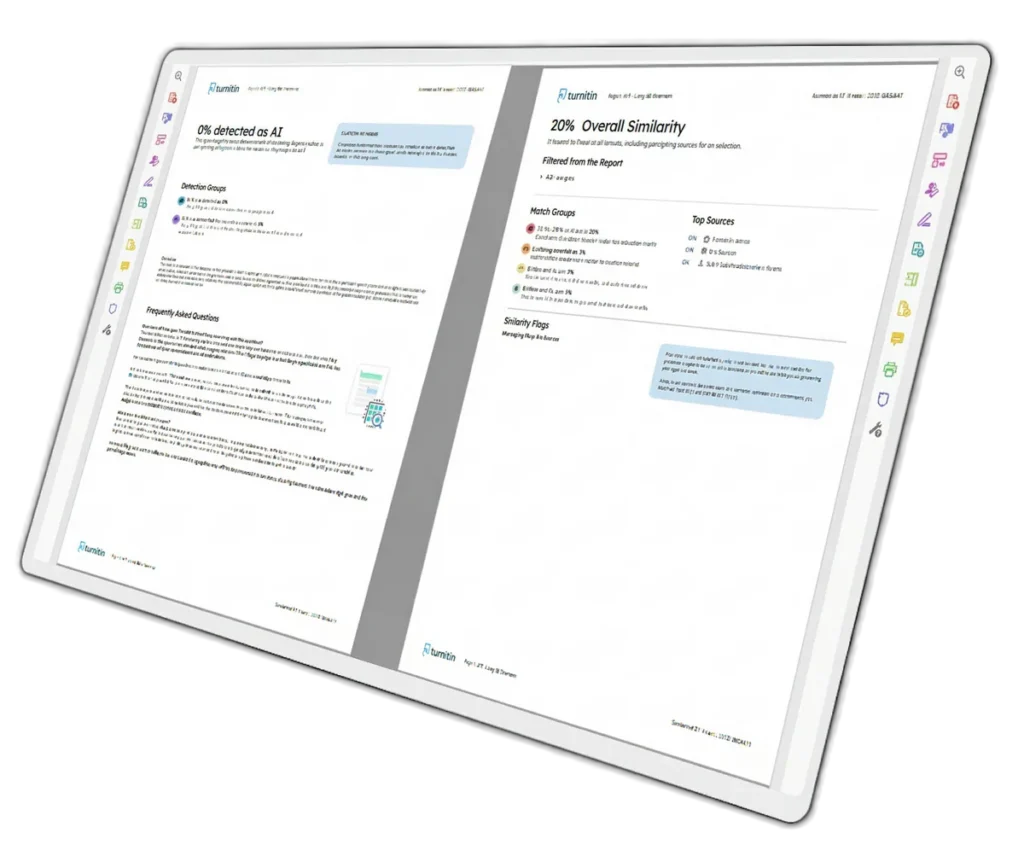
A typical report opens with summary statistics: overall percentage, matching source count, largest single match. The document view overlays color-coded highlighting with numbered superscripts linking to sidebar source navigation. Internet sources link to live URLs; publication sources to database entries; student paper sources to institutional records where permissions permit.
The AI report overlay, when enabled, adds distinct highlighting with toggle controls between similarity and AI views. Comparison with Turnitin sample reports from institutional training materials helps calibrate interpretation across the spectrum of legitimate variation.
Turnitin Compared to Other Plagiarism and AI Checkers
| Tool | Database Scope | AI Detection | Individual Access | Best For |
|---|---|---|---|---|
| Turnitin | 91B+ pages, 1.7B student papers, academic publications | Yes (institutional add-on) | No (institutional only) | Universities, formal assessment |
| Grammarly | 16B web pages, limited academic | Basic | Yes ($12-15/month) | General writing improvement |
| Copyscape | Web-focused only | No | Yes (credit-based) | Website owners, content protection |
| Quetext | Web + academic | Yes (premium) | Yes (freemium) | Budget-conscious individual users |
| Scribbr | Academic (Turnitin-powered) | No | Yes (per-check) | Students needing citation tools |
| Free checkers | Web only | Rare, limited | Yes | Preliminary screening only |
Turnitin vs Grammarly
Grammarly integrates seamlessly with browsers and word processors for real-time checking, but trades convenience against detection depth. Its 16 billion page database lacks Turnitin’s student paper collection and extensive academic licensing . AI detection in Grammarly Premium remains basic compared to Turnitin’s dedicated analysis. For casual writing verification, Grammarly suffices; for academic submission preparation, its limitations are significant.
Turnitin vs Copyscape
Copyscape serves content protection rather than academic verification. Its web-focused model excels at identifying unauthorized republication but misses academic sources, books, and student papers entirely. Use case appropriateness is clear: Copyscape protects published web content; Turnitin verifies original academic work.
Turnitin vs Quetext
Quetext positions as the most accessible alternative for individual users excluded from institutional Turnitin. The freemium model allows limited free checks before credit purchase. However, Quetext lacks Turnitin’s student paper comparison, a critical gap for academic integrity verification. For pre-submission confidence building, Quetext provides valuable indication; for institutional compliance, it cannot substitute official analysis .
Turnitin vs Scribbr
Scribbr operates through formal Turnitin partnership, using licensed technology with student-focused presentation . This creates genuine Turnitin database access for individuals, though AI detection is notably absent. Citation tool integration adds value for students struggling with reference formatting. Per-check pricing suits occasional users, but costs accumulate for regular verification.
Turnitin vs Free Plagiarism Checkers
Free tools including DupliChecker and SmallSEOTools offer basic similarity detection with severe limitations. Database scope typically extends only to indexed web content, missing academic publications and student papers. AI detection is rare and rudimentary. Privacy risks are substantial; free services monetize through advertising and potentially through content harvesting for database building. For preliminary screening, free tools have utility; for submission-critical verification, their inadequacy is clear.
Emerging Turnitin Alternatives for 2026
| Platform | Positioning | Key Features | Limitations |
|---|---|---|---|
| AIDetectPlus | All-in-one platform | Plagiarism, AI detection, humanization, paraphrasing | Algorithm transparency unverified |
| Paperpal | Integrated writing assistance | Detection + grammar, citation, manuscript prep | AI detector training modest vs. institutional scale |
| Winston AI | Individual accessibility | Free trial, HUMN1 certification | Independent accuracy verification limited |
These alternatives address access gaps but cannot replicate Turnitin’s comprehensive database and institutional integration. Users should verify current capabilities through direct testing rather than marketing claims.
Frequently Asked Questions
How Do I Purchase a Turnitin Subscription?
You cannot. Turnitin sells licenses exclusively to educational institutions, not individuals . Students must access through institutional licenses; researchers may use iThenticate at ~$125 per document (similarity only, no AI detection) . To request institutional access, verify availability through your LMS, then advocate through student government or academic integrity offices if absent.
Does Turnitin’s AI Detection System Affect My Assignment Submissions?
AI detection results influence but do not automatically determine outcomes. Scores appear alongside similarity analysis, with institutional policies governing use varying dramatically. Some programs treat AI detection as investigative trigger; others incorporate into grading rubrics; many lack formalized protocols. Separate reporting allows differentiated interpretation; high similarity with low AI suggests uncited borrowing, while low similarity with high AI raises questions about original machine generation.
Does Turnitin Offer a Subscription for Feedback Studio and Similarity?
Product bundling varies by contract. Feedback Studio includes similarity checking plus grading tools; Turnitin Originality adds AI detection as separately purchased upgrade . Feature availability depends entirely on institutional licensing choices, not individual selection.
Can I Get a Turnitin Report Without University Access?
Official alternatives: iThenticate for researchers (similarity only), Scribbr for students (Turnitin-powered plagiarism, no AI detection). Third-party services carry document theft, fraud, and academic integrity violation risks . Recommended substitutes include Quetext for accessible checking and Winston AI for AI-focused detection, with clear understanding of limitations versus full Turnitin capability.
Practical Recommendations
For Students Without Institutional Access
- Verify access thoroughly before assuming absence; many students overlook available resources
- Use legitimate alternatives strategically: Quetext for plagiarism and AI checking, combined tools for cross-validation
- Document your writing process: drafts, timestamps, revision histories protect against erroneous flags
- Consult instructors directly about verification expectations and potential assignment-specific access
For Educators Evaluating Detection Tools
- Request demonstrations covering your specific use cases: discipline-typical sources, student population characteristics, LMS integration requirements
- Prioritize features by program needs: humanities emphasize source database breadth; STEM prioritizes technical writing handling
- Assess total cost of ownership beyond license fees: implementation, training, ongoing support
For Institutions Considering Turnitin
- Initiate evaluation through official contact form; expect representative response within three business days
- Model costs across realistic usage scenarios rather than accepting headline figures
- Invest in training; comprehensive licenses with minimal training undercut implementation value
- Consider complementary and alternative tools to ensure procurement reflects current market conditions