

Use AnswersFountain’s AI content humanization services to pass Turnitin. Learn what your similarity score means and how to get an acceptable Turnitin score.
Getting Real About AI Content Humanization Services
The rise of generative AI changed how people write. Whether you are a student, a blogger, or a professional, tools like ChatGPT help you get ideas on the page fast. But there is a catch. Academic institutions and search engines now use sophisticated tools to spot machine-generated text. This is where AI content humanization services come into play. These services take robotic, predictable text and turn it into something that feels alive and natural. At AnswersFountain, we focus on making your writing indistinguishable from a human-authored piece. Our goal is to help you maintain your voice while passing the strictest checks.
Many people think humanizing text is just about swapping words for synonyms. It is much more complex than that. An effective AI text humanizer looks at sentence structure, rhythm, and the subtle ways humans express ideas. Machines tend to write sentences that are similar in length and complexity. They use a very logical but dry flow. Human writers, on the other hand, vary their pace. They might use a short, punchy sentence to make a point and then follow it with a longer, more descriptive one. Our services mimic these natural patterns so your work reads well and stays under the radar of detection software.
Making Sense of Your Turnitin Score Checker Results
If you have ever submitted a paper to a university portal, you have likely seen a Turnitin report. The Turnitin score checker is the industry standard for identifying unoriginal work. However, the report can be confusing. You might see a percentage and a color, but what do they actually mean for your grade? Understanding these metrics is the first step toward improving your writing.
A Turnitin report provides a similarity index. This index tells you how much of your text matches other sources in their massive database. It is important to remember that a high score does not always mean you plagiarized. It just means the software found matches. This could include your bibliography, properly cited quotes, or even common phrases used in your field of study.
What is a bad Turnitin score?
There is no single number that defines a “bad” score across every institution. Every professor and university has their own rules. However, generally speaking, a bad Turnitin score is one that exceeds the threshold set by your department without a clear explanation. If your paper shows a high percentage of matching text in the main body of your arguments, that is a red flag. It suggests you relied too heavily on other people’s words instead of developing your own ideas.
Most educators look for scores below 15% or 20%. If you go above that, they will likely look closer at the report. They want to see if those matches are just citations or if you copied entire paragraphs. Using AI content humanization services can help you lower these scores by restructuring your sentences so they don’t match existing online content or academic papers.
Is 25% on Turnitin too high?
When you see a 25 Turnitin score, you might start to worry. Is 25% on Turnitin too high? For many undergraduate assignments, 25% is right on the edge. It usually triggers a yellow flag in the system. While it might not lead to an immediate penalty, it will certainly cause your instructor to review your work manually.

Check before you submit. Get Turnitin Score Report in 15 Minutes.
Don't risk the 'Red' score. Get the exact same Turnitin report your supervisor uses. You will receive a full PDF similarity report including AI detection.
If that 25% comes from a very long list of references or long technical terms that cannot be changed, you might be fine. But if it comes from the core of your essay, you need to revise. A 25% score often indicates that you have paraphrased too closely to the original source. You can use an AI text humanizer to rewrite those sections, giving them a fresh structure that maintains the meaning without triggering the similarity flag.
Is 20% on Turnitin okay?
Students often ask if 20% on Turnitin is okay. In most cases, 20% is considered acceptable, especially for complex research papers. It is a common threshold for many master’s and PhD programs as well. However, “okay” is relative. If your 20% score is made up of one solid block of copied text, you are in trouble. If it is spread out across small phrases and citations, you are likely safe.
The key is to check where the matches are happening. If the matches are in your introduction or conclusion, where you should be providing original thought, even a 20% score looks suspicious. Aiming for a lower score by using AI content humanization services gives you a safety net. It shows you put in the effort to make the writing your own.
Is 12% on Turnitin too high?
At the lower end of the scale, people still have questions. Is 12% on Turnitin too high? Generally, no. A 12% score is usually seen as a very good result. It shows that the vast majority of your work is original. Most professors will see a 12% score and move on without a second thought.
However, you should still look at the report. Sometimes a 12% score can hide a specific paragraph that was copied directly. Even at 12%, you want to make sure your citations are perfect. If you used an AI to draft your work and it came out at 12%, you have done a good job of editing, but you still need to verify the content feels human.
Is a 9% Turnitin score ok?
A 9% Turnitin score is almost always considered excellent. It is well below the common 15% threshold. This score suggests that you have done your own research and written your own arguments. Most people would say a 9% score is perfectly fine for any level of academic work.
Is 10 similarity on Turnitin bad? Not at all. A 10% similarity score is very similar to a 9% score. It falls into the “green” zone for Turnitin, meaning it is considered a low risk for plagiarism. Unless your school has an extremely strict 0% policy (which is rare because of bibliographies), you should feel confident with these numbers.
Is 36% similarity on Turnitin bad?
On the flip side, is 36% similarity on Turnitin bad? Yes, in most academic settings, 36% is considered high. This will result in an orange or yellow flag. It tells the instructor that more than a third of your paper matches other sources. This is hard to justify with just citations and references.
A 36% score usually means you need to do a significant rewrite. You might have relied too much on a single source or failed to put ideas into your own words. This is where AnswersFountain can help. Our AI content humanization services can take that 36% and bring it down to a much safer level by completely changing how the information is presented.
AI text to human rewrite service
Understanding Turnitin Score Meaning and Colors
Turnitin uses a color-coding system to give instructors a quick visual guide to your paper. Understanding this Turnitin score meaning helps you know how much work you have left to do.
- Blue: No matching text. This is rare and sometimes even suspicious in research-heavy papers.
- Green: One word to 24% matching text. This is the goal for most students.
- Yellow: 25% to 49% matching text. This requires a manual review and likely some editing.
- Orange: 50% to 74% matching text. This is a major red flag.
- Red: 75% to 100% matching text. This usually indicates total plagiarism.
What does green mean on Turnitin?
When your report is green, it means your similarity index is between 1% and 24%. Most students strive for this. But don’t get complacent. What does green mean on Turnitin? It means you have passed the initial automated filter, but a human could still find issues. Always check the specific matches to make sure you didn’t miss any quotation marks.
Beyond the 25 Turnitin score: The AI writing indicator
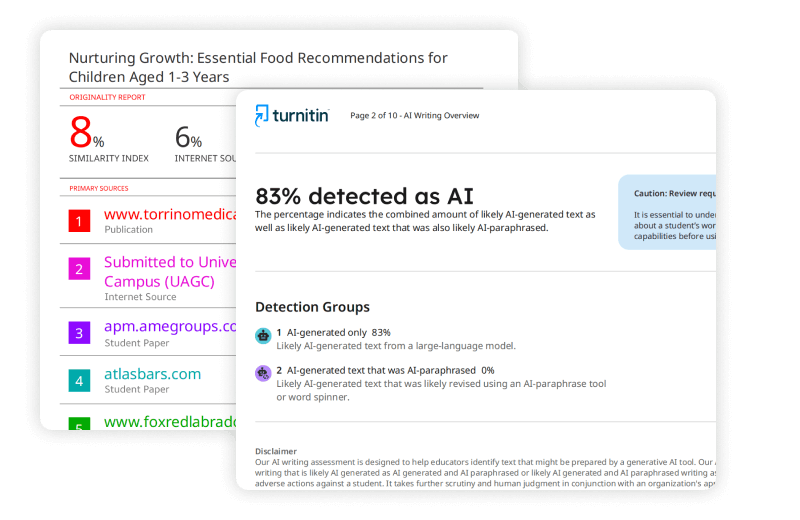
There is a new part of the Turnitin report that you must pay attention to. In addition to the similarity index, Turnitin now has an AI writing indicator. This is a separate percentage that estimates how much of your text was generated by an AI tool like ChatGPT or Claude.
Even if you have a perfect 5% similarity score (green), you could still have a 100% AI detection score. This is why a traditional plagiarism checker is no longer enough. You need an AI text humanizer to address the patterns that AI detectors look for. Turnitin’s AI detector looks for high “predictability” in your word choices. If you want to bypass this, your writing needs to have more “burstiness” and “perplexity.” These are technical terms for how varied and complex your writing is. Our AI content humanization services are designed specifically to increase these metrics.
Why You Need an AI Text Humanizer
The landscape of writing has changed. It is no longer just about whether you copied someone else; it is about whether a human wrote the words. This shift has created a lot of stress for writers who use AI as a helpful assistant. You might use AI to organize your thoughts or overcome writer’s block, but then get flagged for AI writing even though the ideas are yours.
An AI text humanizer acts as a bridge. It takes the structured, logical output of an AI and adds the nuance of human speech. This isn’t just about avoiding detection. It is about making your writing better. Humanized text is more engaging. It flows better. It feels more personal. When you use AI content humanization services, you are investing in the quality of your communication.
The difference between similarity and AI detection
It is important to understand that these are two different things. Plagiarism (similarity) is about content. AI detection is about style.
| Feature | Similarity Score (Plagiarism) | AI Detection Score |
| What it checks | Matches against a database of existing papers and websites. | Statistical patterns common in machine-generated text. |
| Goal | To see if you stole someone else’s work. | To see if you used a tool to write your work. |
| Fix | Paraphrase and cite your sources correctly. | Humanize the text to change its linguistic patterns. |
You can pass one and fail the other. That is why using a tool that handles both is so important. AnswersFountain provides comprehensive AI content humanization services that address both similarity and style.
How AI content humanization services work
Our process at AnswersFountain is sophisticated. We don’t just use a simple “word spinner” that replaces “big” with “large.” Those tools often create weird, unreadable sentences that actually make AI detection easier.
Instead, our AI text humanizer uses advanced language models to understand the context of your writing. We look at the “why” behind your sentences. Our system then rewrites the content using a broader vocabulary and more varied sentence structures. We introduce the slight inconsistencies that make human writing feel authentic. This might mean starting a sentence with a conjunction or using a conversational tone where appropriate. The result is a piece of writing that passes an acceptable Turnitin score check while remaining clear and professional.
How AnswersFountain Solves the AI Detection Problem
We built AnswersFountain because we saw students and professionals struggling with unfair AI detection. Sometimes, even original human writing gets flagged as AI because the writer has a very formal, structured style. This is frustrating and can have serious consequences.
Our AI content humanization services are designed to be a final polish for your work. You provide the draft, and we make it “human.” This process involves several layers:
- Structural Reorganization: We break up long, repetitive sentence chains that are a hallmark of AI.
- Vocabulary Expansion: We move beyond the “safe” words that AI usually picks.
- Tone Adjustment: We ensure the text matches the specific tone you need, whether it is academic, business, or casual.
- Verification: We check the output against common detectors to make sure it passes.
Passing the acceptable Turnitin score threshold
Our primary goal is to help you reach an acceptable Turnitin score. By using our service, you can take a paper that might have been flagged and turn it into a submission that looks clean and original. We help you stay in the green zone (under 24%) for similarity while keeping your AI detection score as low as possible.
We know that for many, a 15% similarity score is the magic number. We work to ensure your text doesn’t just meet that number but stays well below it. Whether you are worried about a 25% on Turnitin or a 36% similarity score, our humanization process can reshape your content to meet institutional standards.
Benefits of using AnswersFountain
When you choose our AI content humanization services, you get more than just a lower score. You get peace of mind. Here is what we offer:
- Originality: Every rewrite is unique. We don’t use templates.
- Readability: We prioritize clarity. Your paper will often be easier to read after we humanize it.
- Speed: We know deadlines are tight. Our service is designed to be fast and efficient.
- Confidentiality: Your work is yours. We do not store or share your submissions.
- Accuracy: We keep your original meaning intact. We don’t change your facts; we only change the way they are expressed.
AI text to human rewrite service
Practical Tips to Lower Your Turnitin Similarity Index
While using an AI text humanizer is the most effective way to change your scores, there are manual steps you can take as well. Combining these tips with our services will give you the best possible results.
Use Direct Quotes Sparingly
If your similarity score is high, check how many direct quotes you have. Turnitin will flag these. Try to paraphrase the ideas and provide a citation instead. When you paraphrase, don’t just change two or three words. You need to change the entire sentence structure.
Focus on Your Analysis
A good academic paper should be mostly your own analysis. If you find yourself quoting someone else for three sentences and only writing one sentence of your own, your score will be high. Aim for a ratio where your voice is the loudest in the room.
Check Your Bibliography
Sometimes a 25 Turnitin score is caused entirely by the bibliography. If your professor allows it, you can tell Turnitin to ignore the bibliography when it runs the report. This can instantly drop your score by 5% or 10%.
Use Active Voice
AI often leans on passive voice because it sounds objective. However, humans naturally use active voice more often. Switching “The study was conducted by researchers” to “Researchers conducted the study” changes the pattern and makes the writing more direct.
Vary Sentence Length
This is the number one thing an AI text humanizer does. You can do it too. If you have three sentences in a row that are all ten words long, change them. Make one very short. Make one longer and more complex. This breaks the machine pattern.
Frequently Asked Questions About Turnitin and AI Detection
We get a lot of questions about how these systems work. Here are some of the most common ones we hear at AnswersFountain.
What is a bad Turnitin score for a thesis?
For a thesis or dissertation, expectations are higher. Many universities want to see a similarity score under 10%. Since a thesis is supposed to be an original contribution to your field, a high similarity score is viewed very critically.
Does Turnitin save my paper?
Yes, usually. When you submit to a university portal, Turnitin adds your paper to its global database. This means if you submit the same paper again later, it will show a 100% match. This is called self-plagiarism. If you are using a Turnitin score checker privately before your final submission, make sure you are using one that does not save your paper to the repository.
Can Turnitin detect ChatGPT-4?
Yes. Turnitin updated its algorithms specifically to catch text from GPT-3.5, GPT-4, and other large language models. They look for the statistical signature of these models. This is why using a basic rewriter is no longer enough. You need the deep humanization that we provide at AnswersFountain.
How accurate is the AI detection score?
It is not 100% accurate. There are cases of “false positives,” where human writing is flagged as AI. However, universities often trust the tool. If you get a high AI score, it is on you to prove you wrote it. Having a humanized version of your text makes it much harder for these tools to make a false claim against you.
What should I do if my score is 36%?
If your score is 36%, don’t panic, but do act. You need to identify which sources are causing the match. If it is one specific website, you need to rewrite those sections completely. Use our AI text humanizer to give those paragraphs a completely new look. This is usually enough to bring the score back down into the green zone.
Final Thoughts on Humanizing Your Writing
The goal of writing is to communicate ideas. AI is a tool that can help us do that faster, but it shouldn’t replace the human element. Whether you are worried about “is 20% on Turnitin okay” or trying to understand your Turnitin score meaning, the solution is the same. You need to make sure your work reflects human creativity and variation.
AI text to human rewrite service
At AnswersFountain, we are here to help you navigate this new world of AI detection. Our AI content humanization services give you the tools to use AI responsibly while still meeting the high standards of your school or workplace. Don’t let a machine-generated score define your success. Take control of your writing, lower your similarity index, and submit your work with confidence.