

Is Turnitin worth the cost? We break down pricing, features, accuracy, and alternatives so you can decide if this plagiarism checker fits your needs.
Is Turnitin Worth the Cost? A Straight Talk Breakdown for Students and Educators
You have probably stared at a Turnitin similarity score report at 11 PM the night before a deadline, heart pounding, wondering if that 18% match means trouble. Or maybe you are an instructor weighing whether your department should renew that institutional license for another year. Either way, the question hits the same: is Turnitin actually worth what you pay for it?
Turnitin dominates the academic integrity space for a reason. It has been around since the late 1990s, built a massive database of student papers and published works, and integrated deeply into learning management systems like Canvas, Moodle, and Blackboard. But dominance does not automatically equal value. In 2026, the landscape looks different. AI detection has become a core concern, competitors have gotten sharper, and students have more options than ever for checking their work before submission. So let us cut through the brand recognition and look at what Turnitin delivers, what it costs, and where it falls short.
What You Actually Get for Your Money
Turnitin is not a single product. It is a suite of tools bundled under one umbrella, and what your institution pays for depends on which pieces they license. The core offerings include the similarity checker, the AI detection tool, Feedback Studio for grading and commenting, and iThenticate for researchers and publishers. Some schools also add Gradescope for exam grading or Draft Coach for real-time writing support.
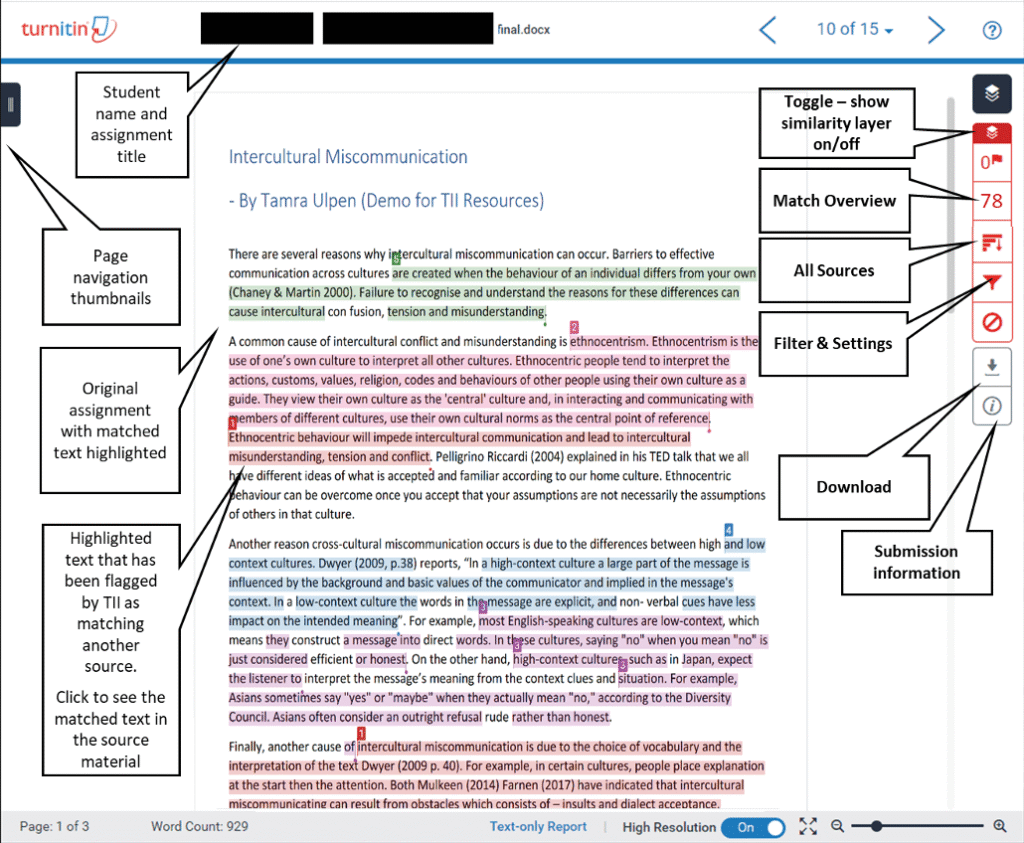
The similarity checker remains Turnitin’s strongest feature. It compares submissions against a database that includes billions of web pages, millions of journal articles, and over a billion previously submitted student papers. When it finds matches, it generates a Turnitin score report with color-coded percentages. Blue means no matches. Green covers 1% to 24% similarity. Yellow runs 25% to 49%. Orange hits 50% to 74%, and red means 75% to 100% overlap with existing sources. These colors help instructors scan quickly, but the percentage itself is just a starting point. A well-cited research paper with a 30% score might be completely legitimate, while a 5% score could hide a single paragraph copied verbatim without attribution.
The AI detection tool is newer and more controversial. Turnitin launched it in response to ChatGPT and the flood of AI-generated submissions that followed. The company claims over 98% accuracy on unmodified AI text with a false positive rate below 1% for documents scoring above 20% AI-generated content. Independent testing tells a more complicated story. Research from Stanford’s Human-Centered AI Institute found that AI detectors flagged 61% of non-native English student essays as AI-written, a severe and systematic bias that disproportionately affects international students. Real-world false positive rates on non-native writing and heavily edited drafts have been documented between 5% and 12% in independent studies. Vanderbilt University publicly disabled Turnitin’s AI detection feature after concluding the false positive risk was unacceptably high.
The Pricing Problem Nobody Talks About
Here is where things get frustrating. Turnitin does not publish standard pricing. You cannot visit their website, pick a plan, and check out with a credit card. The company operates on an institutional quote model, which means your university or school negotiates privately with Turnitin sales representatives. An investigation into 60 institutions’ purchasing records revealed that Turnitin charges some colleges three times as much as others for similar requirements. This opacity makes it nearly impossible for individual teachers or students to know what their access actually costs.
For students, the situation is worse. Turnitin does not sell individual licenses. If your school subscribes, you use it through their portal. If your school does not subscribe, you are out of luck. You cannot buy a personal Turnitin plagiarism check for your essay before submitting it to a journal or another institution. This gap has created an entire market of third-party services claiming to offer Turnitin checks, many of which are unreliable or overpriced.

Check before you submit. Get Turnitin Score Report in 15 Minutes.
Don't risk the 'Red' score. Get the exact same Turnitin report your supervisor uses. You will receive a full PDF similarity report including AI detection.
The closest official option for individual users is iThenticate, Turnitin’s sister product aimed at researchers, authors, and publishers. iThenticate operates on a per-document or subscription basis and checks against many of the same academic databases. It does not include the student paper repository, so it is less useful for catching collusion or recycled coursework. It also lacks the AI detection features that have become standard in Turnitin’s academic product.
Where Turnitin Shines
Despite the pricing headaches and AI detection controversies, Turnitin still holds real advantages that competitors struggle to match.
The database depth is unmatched. No other plagiarism checker has indexed over a billion student submissions across decades. This matters because student collusion, where one student copies another’s work from a previous semester, is a genuine problem that web-only checkers completely miss. If you are running a large university and need to catch recycled assignments, Turnitin’s repository is a genuine asset.
LMS integration is another strong point. Turnitin plugs directly into Canvas, Moodle, Blackboard, and other major platforms. Students submit through the same portal they use for everything else. Instructors grade within the same workflow. The friction is minimal, which matters when you are processing thousands of submissions per semester.
The similarity report interface has also improved over time. Instructors can filter matches by source type, exclude bibliographies and quoted material, and drill down to specific sentences. The Turnitin score report includes a match list showing exactly which sources triggered the similarity percentage, and the color coding makes it easy to spot submissions that need closer inspection.
For institutional compliance and record-keeping, Turnitin offers audit trails and administrative controls that smaller competitors often lack. Universities dealing with accreditation reviews or academic integrity investigations need documentation, and Turnitin provides it.
Where Turnitin Falls Short
The AI detection tool is the most obvious pain point. Turnitin’s Chief Product Officer Annie Chechitelli has publicly acknowledged that the system deliberately accepts missing up to 15% of AI-written text to keep false positive rates low. In practice, this means lightly edited AI content, mixed human-AI authorship, and heavily revised drafts often slip through. A student who generates a draft with ChatGPT and then rewrites every paragraph in their own voice may produce a submission that Turnitin flags as entirely human-written.
Turnitin alternatives for students
The false positive problem cuts the other way too. Clean, structured academic writing, formal prose, and technical writing can trigger AI flags in human-written work. Students using grammar tools or writing in a second language face higher false accusation risks. The 4% sentence-level false positive rate means roughly 1 in every 25 human-written sentences gets wrongly flagged. In a standard 650-word college essay, that translates to 2 or 3 false flags minimum.
Data retention policies also raise concerns. Turnitin contractually stores assignments for up to 180 days after a class end date, with classes typically lasting twelve months from creation. While the company states it makes reasonable attempts to store papers in perpetuity, students have limited control over their intellectual property once submitted. Paper deletion requests must go through institutional administrators in writing, adding bureaucratic friction for students who want their work removed from the database.
The lack of individual access is perhaps the most practical limitation. Students who want to check their work before final submission, freelancers verifying originality for clients, or researchers preparing manuscripts cannot simply buy a Turnitin plagiarism check. They must rely on institutional access or seek alternatives.
What Are You Actually Paying For?
To evaluate whether Turnitin is worth the cost, you need to separate the components and ask which ones you actually need.
If your primary concern is catching copy-paste plagiarism from the web, free tools like DupliChecker or SmallSEOTools handle basic checks reasonably well. They will not catch student collusion or match against paywalled journal databases, but for web-based similarity checking, they work.
If you need AI detection, the field has exploded with options. GPTZero offers sentence-level AI detection with a 99.5% accuracy rate according to the Chicago Booth Benchmark, plus a free tier for basic use. Copyleaks provides plagiarism and AI detection starting around $13 per month for individuals, with extensive LMS integrations. Originality.ai targets content marketers and publishers but works for academic use at $14.95 per month. Winston AI claims 99.85% accuracy with a 0.032% false positive rate, though independent verification of these figures remains limited.
If you need grading and feedback tools, Turnitin’s Feedback Studio competes with dedicated grading platforms like Gradescope, which Turnitin actually acquired, and newer AI-assisted grading tools that offer rubric generation and automated essay scoring. The value here depends on whether your institution already uses these features or if instructors grade manually.
If you are an individual student or researcher who simply wants to verify originality before submission, Turnitin is not built for you. iThenticate is the official alternative, but it is priced for professional publishers and lacks student-paper matching. Third-party services claiming to offer genuine Turnitin checks operate in a gray area, and many are overpriced or slow.
Comparing the Real Costs
Let us look at what alternatives actually cost in 2026, since Turnitin itself will not tell you its price without a sales call.
| Tool | Starting Price | Individual Access | AI Detection | Student Paper Database | Best For |
|---|---|---|---|---|---|
| Turnitin | Quote-based only | No | Yes | Yes | Large institutions |
| iThenticate | ~$100 per 100 credits | Yes | No | No | Researchers, publishers |
| GPTZero | Free tier; $12.99/month premium | Yes | Yes | No | Teachers, students |
| Copyleaks | $13/month individual | Yes | Yes | Limited | Universities, multilingual |
| Originality.ai | $14.95/month | Yes | Yes | No | Content teams, agencies |
| Grammarly Premium | $12/month | Yes | Weak | No | Grammar, basic plagiarism |
| Scribbr | $19.95 per check | Yes | No | No | One-off thesis checks |
The pattern is clear. Turnitin bundles features that competitors sell separately, but it locks everything behind institutional contracts. For a small college or individual teacher, paying for Copyleaks or GPTZero plus a dedicated grading tool might deliver 90% of Turnitin’s functionality at a fraction of the cost and with transparent pricing.
For students, the math is simpler. If your school provides Turnitin, use it. If not, a combination of free plagiarism checkers and a low-cost AI detector like GPTZero’s free tier gets you most of the way there. The gap is the student paper database, which only Turnitin and a few institutional competitors maintain.
When Turnitin Makes Sense
Turnitin is worth the cost in specific scenarios. Large universities with thousands of students need the repository matching to catch recycled work across semesters. Institutions with strict academic integrity policies benefit from the audit trails and administrative controls. Schools already deeply integrated into Canvas or Moodle save implementation headaches by sticking with a familiar workflow.
If your department processes 10,000 submissions per year and catching even a few dozen cases of student collusion prevents grade inflation or integrity scandals, the license pays for itself in reputation protection alone. The similarity checker is mature, reliable, and deeply embedded in academic culture. Professors know how to read the reports. Students know what the percentages mean. That familiarity has value.
When You Should Look Elsewhere
Turnitin is harder to justify when the core need is AI detection. The tool was built for similarity checking, and the AI detection layer feels like a rushed response to ChatGPT rather than a purpose-built solution. If AI detection is your priority, specialized tools offer higher accuracy claims and lower false positive rates, though every detector in this space struggles with heavily edited or humanized content.
Individual users should almost certainly look elsewhere. The inability to buy a personal Turnitin plagiarism check is a dealbreaker for freelancers, independent researchers, and students at schools without subscriptions. iThenticate is too expensive and too narrow for most student needs.
Small institutions and individual teachers face a different calculation. The quote-based pricing model means you cannot comparison shop easily. You might end up paying premium rates for features you rarely use, like the full Feedback Studio suite, when a simpler plagiarism checker and your existing LMS grading tools would suffice.
The Honest Verdict
So is Turnitin worth the cost? It depends on who you are and what you need.
If you run a large university and need comprehensive similarity checking across a massive student body, yes. The database depth, institutional controls, and LMS integration justify the expense even if the pricing is frustratingly opaque. Turnitin remains the standard for a reason.
If you are an individual student or teacher, probably not. You cannot buy it directly, the AI detection has documented accuracy problems, and competitors offer similar functionality with transparent pricing and individual access. A Turnitin score report is useful, but it is not the only way to verify academic integrity.
If you need AI detection specifically, look at specialized tools. Turnitin’s 98% accuracy claim applies to unmodified AI text in ideal conditions. Real-world performance on edited drafts, non-native English, and mixed authorship is significantly weaker. The false positive risk to students, particularly international students, is real and documented.
The bottom line is that Turnitin is a solid tool with real limitations. It excels at what it was originally built for: similarity checking against a massive database of existing work. It struggles with newer challenges like AI detection and individual accessibility. Whether it is worth the cost comes down to whether your needs align with its strengths or its weaknesses.
If you need a Turnitin score report before submitting to a journal, or you want to check your essay for both similarity and AI flags before your professor sees it, answersfountain.com offers reliable Turnitin report services and AI humanizing tools that fill the gaps Turnitin leaves open. Sometimes the best approach is not choosing one tool, but combining the right ones for your specific situation.