

Learn what really affects your Turnitin AI detection score. We separate myths from reality so you stop wasting time on tactics that don’t work.
How to Get 0% AI Detection on Turnitin (Myths vs Reality)
If you’ve searched for ways to get 0% AI detection on Turnitin, you’ve probably landed on pages promising magic tricks, tool hacks, or rewriting loops. Most of it is noise. This page cuts through the clutter and tells you exactly how Turnitin’s AI detection actually works, which popular “fixes” are myths, and what the data says about where the system genuinely struggles. If you’re a student, educator, or researcher trying to understand what a Turnitin check is actually measuring, this is the honest breakdown you need.
How Turnitin’s AI Detection Actually Works
Before you can understand what a 0% AI score means, you need to know what the tool is measuring. Turnitin does not search a database of ChatGPT outputs the way it searches for plagiarism. The two systems are completely separate and use entirely different logic.
The AI detector uses a transformer-based machine learning model trained on millions of examples of both human writing and AI-generated text. When you submit a paper, Turnitin breaks it into segments of roughly 250 words and analyzes two primary signals in each segment.
Perplexity
This measures how predictable the word choices are. When a large language model writes, it statistically selects the most probable next word at each step. The result is text with very low perplexity. Human writing tends to be less predictable because people make unexpected word choices, skip words, write awkward sentences, and generally deviate from the statistically “correct” path.
Burstiness
Human writing has rhythm variation. Some sentences are short. Some stretch across several clauses with multiple ideas competing for space. AI writing tends to produce consistently medium-length sentences with uniform structure. Burstiness measures that variation. Low burstiness is a signal that a model might be involved.
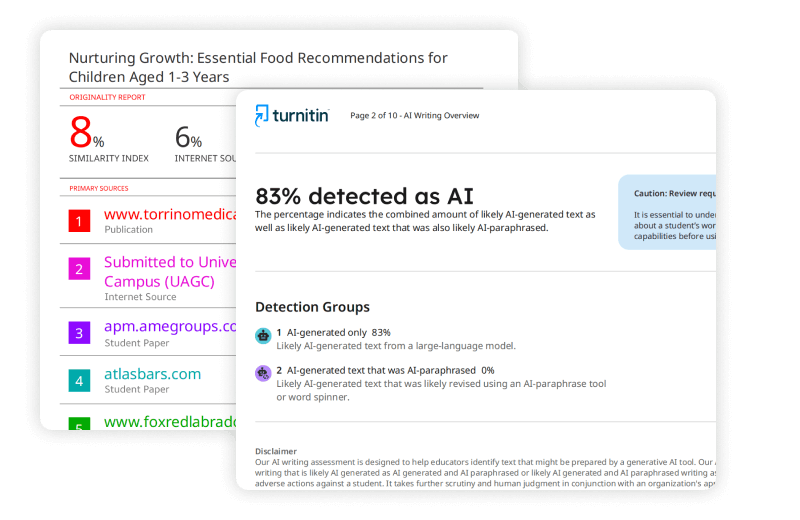
Since July 2024, Turnitin added a separate AI paraphrasing detection layer (model AIR-1), specifically trained to catch text that was AI-generated and then run through a paraphrasing tool like QuillBot. That content shows up highlighted in purple in the report, separate from the cyan highlighting for standard AI-generated text. An anti-humanizer update followed in August 2025.
98%Turnitin’s claimed accuracy on long, unedited AI outputs

Check before you submit. Get Turnitin Score Report in 15 Minutes.
Don't risk the 'Red' score. Get the exact same Turnitin report your supervisor uses. You will receive a full PDF similarity report including AI detection.
61%False positive rate for non-native English writers, per Stanford HAI research
<300Words where Turnitin openly admits results become less reliable
20–63%Detection accuracy range when AI text has been edited or paraphrased
The Score Itself: What 0%, *%, and 20%+ Actually Mean
One thing that trips up a lot of students is that 0% does not mean “perfectly human.” It means Turnitin did not detect enough patterning consistent with AI-generated text to cross its confidence threshold. Those two things are different.
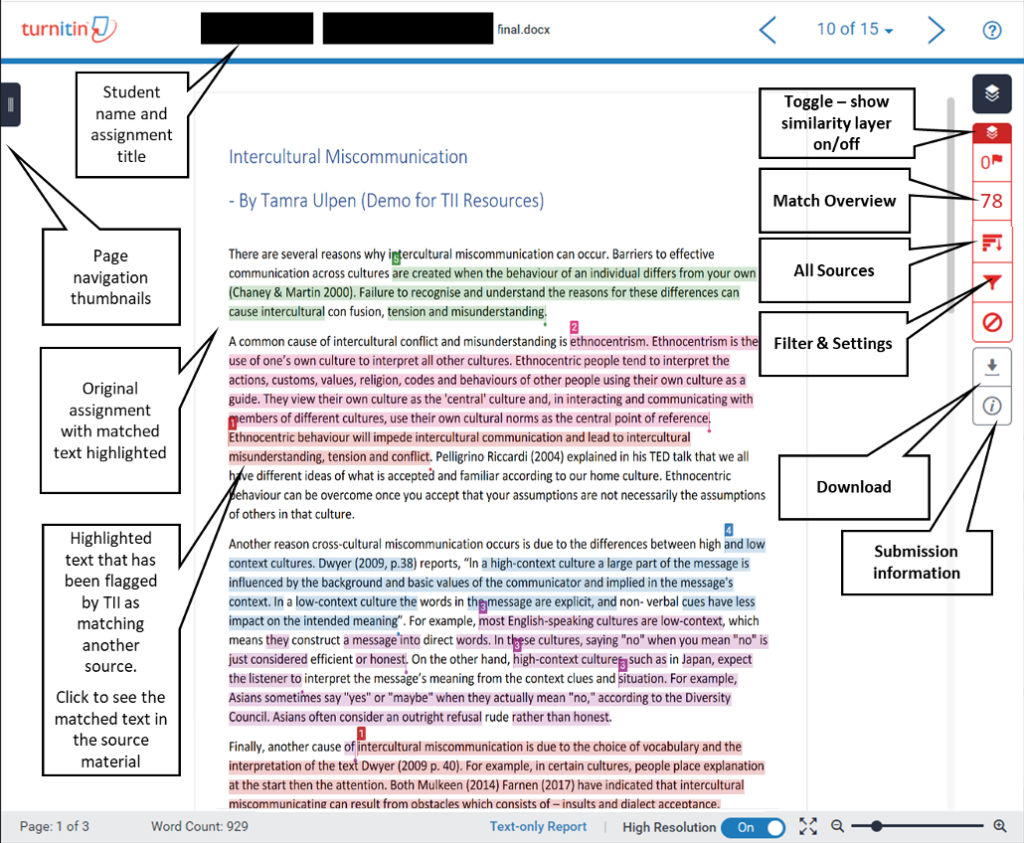
As of July 2024, Turnitin changed how it displays low scores. If a submission scores between 1% and 19%, the report shows an asterisk (*%) instead of a number. Turnitin explains this openly: false positives are significantly more common in that lower range, so they hide the number to reduce misinterpretation. A *% result is generally treated as acceptable at most institutions.
Key Point
Turnitin will only generate an AI Writing Report at all if the submission contains between 320 and 29,999 words of qualifying prose text. Bullet-point lists, citations, headers, and code blocks are excluded from the AI check. A paper made up mostly of those elements may simply not generate a meaningful AI score.
The percentage you see on a Turnitin check represents the proportion of qualifying text that the model flagged as likely AI-generated. It is separate from and has no effect on your similarity (plagiarism) score.
Common Myths About Getting 0% AI Detection on Turnitin
This is where the internet gets loud and wrong. Let’s go through the most common claims you’ll see.
Myth 1: Running Your Text Through a Paraphrasing Tool Will Clear the AI Score
Myth
“Just paste your ChatGPT output into QuillBot, then submit. Turnitin won’t see it.”
Reality
Turnitin’s July 2024 update specifically targeted AI paraphrasing. The model was retrained to detect text that was AI-generated and then spun through a paraphrasing tool. That output now shows up in purple highlighting in the report. Independent testing shows Turnitin still detects 64% or more of QuillBot-paraphrased AI content.
Myth 2: Switching to a Less Common AI Tool Will Avoid Detection
Myth
“Turnitin only knows about ChatGPT. Use Claude or Gemini and you’ll fly under the radar.”
Reality
The detector targets writing patterns, not specific tools. That said, testing does show variation across models. GPT-4 and Google Gemini outputs are detected at 98–100% accuracy in independent studies. Anthropic’s Claude produces more volatile detection results, with some outputs scoring only in the 53–60% range above the 90% AI-likelihood threshold. But that is far from a reliable escape, and these detection gaps narrow with each model update Turnitin releases.
Myth 3: Adding Personal Anecdotes or Typos Will Drop the Score to Zero
Myth
“Insert a few personal stories and some deliberate typos. The algorithm won’t flag it.”
Reality
Turnitin analyzes segments of your text independently. If 60% of your paper is AI-generated and 40% is human-written additions, it may still flag the AI-generated segments in a Turnitin check. Inserting errors into AI text superficially changes the surface of the text without fundamentally changing the statistical patterns the model measures. Sentence structure, word choice distribution, and syntactic patterns are harder to mask by adding typos.
Myth 4: Translating to Another Language and Back Will Fool the Detector
Myth
“Translate your AI text to Spanish and back to English. The AI patterns disappear.”
Reality
Translation does introduce more linguistic variation and can lower detection rates in some cases. But Turnitin has now added Spanish language AI detection, and the English model is still applied to the final English output. The bigger risk here is that the translation process itself often produces awkward, stilted English that raises instructor suspicion far more than a moderate AI score would.
Myth 5: Turnitin’s AI Detector Is Infallible
Myth
“If Turnitin says 80% AI, the student definitely used AI. The system doesn’t lie.”
Reality
This one matters a lot. Turnitin’s own documentation says the tool “may not always be accurate” and “should not be used as the sole basis for adverse actions against a student.” A 2023 Stanford Human-Centered AI study found that seven major AI detectors flagged 61% of essays written by non-native English speakers as AI-generated. That is a serious false positive problem. Structured, formal academic writing in English from someone who learned it as a second language can pattern-match closely with AI output.
Where Turnitin’s AI Detection Actually Struggles
Rather than chasing myths, it’s more useful to understand where the system genuinely has limitations. These are not exploits. They’re documented weaknesses that Turnitin itself acknowledges.
| Scenario | Detection Accuracy | Why It Matters |
|---|---|---|
| Long, unedited GPT-4 essay | 90–98% | The system is strongest here. Raw AI output is reliably flagged. |
| Heavily edited AI draft (manual rewrite) | 20–63% | Significant accuracy drop when a human substantially reworks the text. |
| Non-native English writer’s own work | Up to 61% false positive | Formal ESL writing can mimic AI patterning. Turnitin’s biggest documented flaw. |
| Short submissions (<300 words) | Lower / unreliable | Turnitin openly states results are less accurate on short texts. |
| Technical or highly structured writing | Variable | Formal prose in law, science, or engineering naturally patterns similarly to AI. |
| Hybrid text (mix of human + AI) | Weakest accuracy | Segment-level detection struggles to separate interleaved human and AI writing. |
What Actually Results in a Genuine 0% Turnitin AI Score
There is one reliable path to a 0% AI detection score on Turnitin. Write your own work. That sounds obvious, but it is worth saying plainly because everything else on this list requires you to start there first.
Write From a Draft, Not a Prompt
Your own writing has a structure that reflects your thinking process. It has false starts, perspective shifts, and sentence-level decisions that AI models don’t replicate. Turnitin’s burstiness measurement captures this variation. A paper that went through multiple genuine drafts carries that pattern throughout.
Use AI as a Research Aid, Not a Writer
There is a meaningful difference between asking an AI tool to “write my essay on climate policy” and asking it to “summarize the key arguments in the Paris Agreement.” Using AI for information gathering, outlining, or fact-checking and then writing your analysis in your own voice produces human-written text. That text will score low on any Turnitin AI check because it is genuinely human.
Understand Your Institution’s Rules
Many universities now permit disclosed AI use for certain tasks. Some programs allow AI for outlining or grammar checks but not for drafting. Knowing exactly where your institution draws the line matters both for compliance and for how you approach your work. A disclosed, limited use of AI within permitted boundaries is categorically different from submitting AI-generated work as your own.
Request a Turnitin Score Check Before Final Submission
If your institution allows it, running a preliminary Turnitin check can show you where the detector is flagging text before your instructor sees the report. Some third-party tools attempt to replicate Turnitin’s output for pre-submission review, though results can vary. What matters is that any text you subsequently revise to address those flags should be rewritten by you, not by another AI tool.
What Happens When Turnitin Flags Your Paper
A high AI score on a Turnitin check is not an automatic academic misconduct finding. Turnitin explicitly states this, and most institutions with responsible AI policies treat the score as a prompt for conversation, not a verdict.
In practice, the process typically looks like this:
- The instructor reviews the AI writing report and considers the score in context.
- They may compare the flagged passages against the student’s other submitted work.
- They may ask the student to walk through their writing process or explain specific arguments.
- If misconduct is suspected, the case goes to the institution’s academic integrity office.
- Only then can a formal finding be made, with the student having the opportunity to respond.
A student who genuinely wrote their own paper but received a high AI score due to writing style, ESL background, or discipline conventions has a strong case to make in that conversation. The detector’s output is one data point, not a conclusion.
AI Detection vs. Plagiarism Check: Not the Same Thing
Students often conflate the similarity score and the AI detection score on a Turnitin check. They operate on completely different systems.
The similarity score compares your text against Turnitin’s database of 1.9 billion academic submissions, websites, and publications. It finds matching text strings. A 30% similarity score means 30% of your text matches something in that database, which can include your own properly cited sources.
The AI detection score does not reference that database at all. It runs a probabilistic model against your text and returns a likelihood estimate. The two scores are displayed separately and do not influence each other.
You can have a 0% similarity score (no plagiarism) and a 90% AI score (likely AI-generated). You can also have a 20% similarity score (lots of quoted sources) and a 0% AI score (you wrote all the analysis yourself). Understanding which score means what is basic to reading a Turnitin report accurately.
The Bigger Picture: Why Chasing 0% Often Backfires
Here is something worth sitting with. The time students spend trying to lower an AI detection score through paraphrasing loops, translation tricks, and humanizer tools often exceeds the time it would have taken to write a decent paper. And the output after all that processing is frequently worse: choppy, grammatically awkward, inconsistent in tone, and logically thin.
Instructors read a lot of student writing. They notice when a paper sounds nothing like the student’s previous work, even if the Turnitin check comes back clean. A 0% AI score on a paper with shallow arguments, vague transitions, and no evidence of engagement with course material can raise more questions than a 30% score on a paper that clearly reflects genuine thinking.
Detection technology and writing quality are separate dimensions. Optimizing only for the first one at the expense of the second is a losing strategy, and it misses the actual point of the assignment entirely.
Quick Reference: Myths vs. Reality
| What People Claim | What the Evidence Says |
|---|---|
| Paraphrasing tools bypass AI detection | Turnitin specifically detects AI-paraphrased text since July 2024 |
| Non-ChatGPT AI avoids detection | Partially true for some models but unreliable and shrinking as a gap |
| Adding typos or anecdotes tricks the system | Surface edits don’t change underlying statistical patterns |
| A high AI score means academic misconduct | No. It is a probabilistic signal, not a verdict. ESL writers face high false positive rates. |
| Turnitin’s similarity and AI scores are linked | They are completely separate systems with no shared logic |
| Submissions under 300 words are safe from detection | True that accuracy drops, but Turnitin still flags short texts; results are just less reliable |
| A 0% AI score guarantees no follow-up from instructors | No. Instructors use judgment beyond the score, including writing quality and consistency |
Final Thoughts
Turnitin’s AI detection is a capable but imperfect probabilistic tool. It catches raw AI output reliably. It struggles significantly with edited text, short submissions, non-native English writing, and hybrid documents. The idea of reliably achieving 0% AI detection by gaming the system is largely a myth: the cat-and-mouse between humanizer tools and Turnitin’s detection models moves quickly, and most workarounds become obsolete within months of an update.
If your goal is a clean Turnitin score check, the path is straightforward. Write your own work, use AI tools only where your institution explicitly permits it, and understand what the report is actually measuring. That gives you a foundation to stand on if questions arise, which no paraphrasing tool can provide.
A note on academic integrity: This page explains how Turnitin’s AI detection system works so students and educators can interpret results accurately. It is not intended as guidance on bypassing academic integrity policies. Always follow your institution’s rules regarding AI use in academic submissions.
How to Get 0% AI Detection on Turnitin (Myths vs Reality)