

Does Turnitin detect paraphrasing or rewriting? Learn how Turnitin checks work, what gets flagged, and how to write original content that passes every time.
Does Turnitin Detect Paraphrasing or Rewriting? A Full Guide for 2026
You finish your essay, run it through a paraphrasing tool, and feel confident. The sentences look different. The words have changed. You run a quick Turnitin check in your head and assume you are safe. Then the similarity report comes back with flags you did not expect, or worse, the AI detection score lights up in purple. What happened?
Students ask this constantly. The short answer is yes, Turnitin detects paraphrasing and rewriting, but not in the way most people think. It does not simply hunt for matching words. It analyzes structure, probability, and writing patterns. Understanding how this works saves you from accidental plagiarism flags and wasted hours rewriting content that still gets caught.
This guide breaks down exactly how Turnitin checks for paraphrased content, what separates poor rewriting from genuine originality, and how you can write in a way that passes both the similarity scanner and the AI detector.
How Turnitin Actually Works: Two Separate Systems
Most students treat Turnitin like a single plagiarism checker. It is not. When you submit a paper, Turnitin runs two completely independent analyses that produce two different scores .
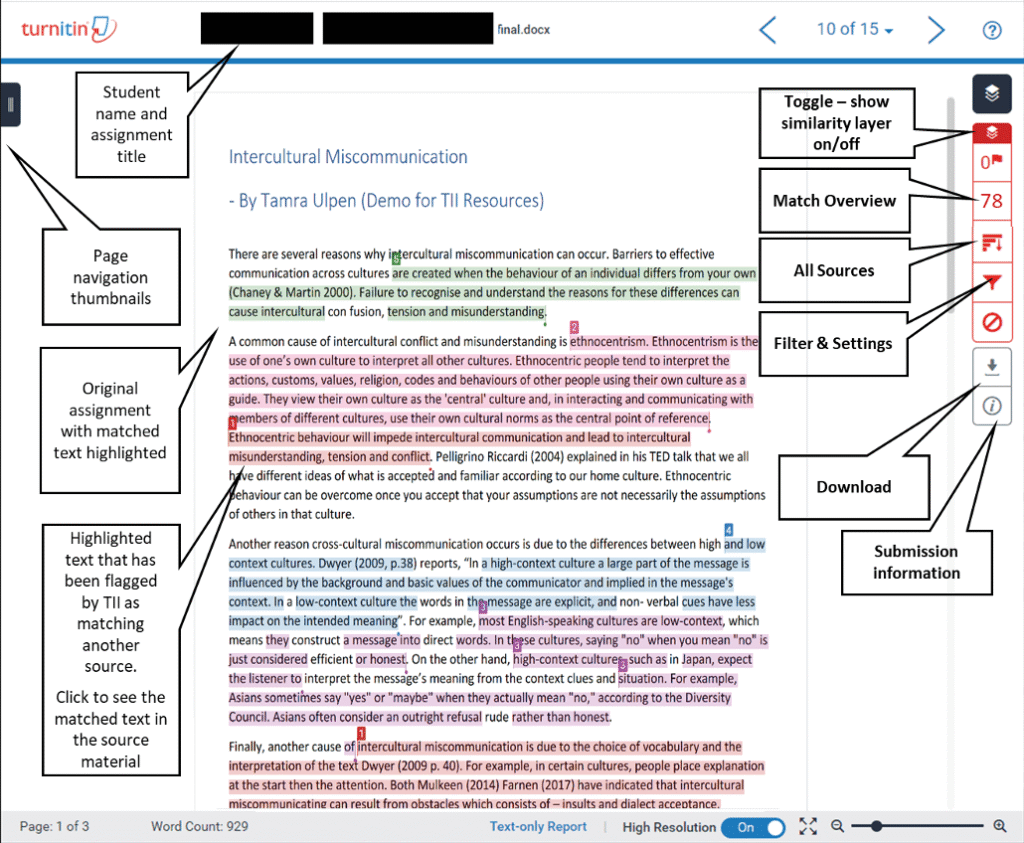
The first is the Similarity Report. This compares your text against billions of web pages, academic journals, books, and previously submitted student papers. It highlights matching text and calculates a similarity percentage. A 20% score does not mean 20% of your paper is plagiarized. It means 20% of your text matches something in the database, which could include properly cited quotes, common phrases, or standard terminology in your field.
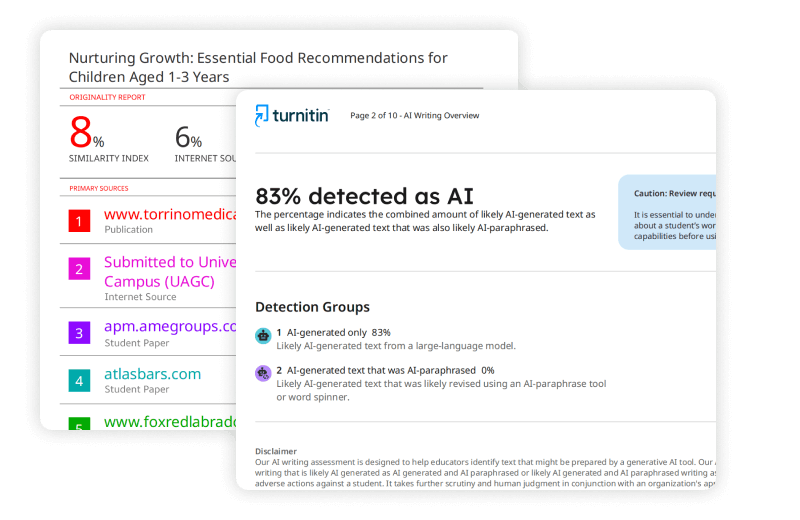
The second is the AI Writing Detection Report. Turnitin added this in April 2023 and has updated it significantly through 2025 and 2026. This system does not compare your text to existing sources. Instead, it uses a sentence-level classification model that assigns each sentence a probability of being AI-generated. The final score reflects the percentage of sentences the model believes were written by AI .
These two scores operate independently. You can have 0% similarity and still get flagged for AI writing. You can have high similarity with no AI flag at all. Understanding this distinction matters because the strategies for beating each system are completely different.

Check before you submit. Get Turnitin Score Report in 15 Minutes.
Don't risk the 'Red' score. Get the exact same Turnitin report your supervisor uses. You will receive a full PDF similarity report including AI detection.
According to Turnitin’s February 2026 data release, approximately 15% of essay submissions now contain more than 80% AI-generated writing, up from roughly 3% when the AI detector first launched . That five-fold increase is exactly why universities now scrutinize both reports, and why you need to understand what each one measures.
Can Turnitin Detect Paraphrasing? Yes, and Here Is How
Turnitin catches paraphrasing through its Similarity Report, but its success depends entirely on the quality of your rewriting. If you swap a few synonyms and keep the original sentence structure, Turnitin will likely flag it. If you thoroughly restructure the idea in your own voice, it probably will not.
Poor Paraphrasing: What Turnitin Catches Easily
Poor paraphrasing, sometimes called patchwork or mosaic plagiarism, happens when you stitch together slightly altered phrases from various sources without truly changing the structure. Turnitin’s algorithm recognizes these patterns because the logical flow and sentence architecture remain too close to the original .
For example, if the original text reads: “The rapid industrialization of the 19th century led to significant urban migration and the expansion of the working class,” and you rewrite it as: “The quick industrial growth of the 1800s caused major city movement and the growth of laborers,” Turnitin may still flag this. You changed words, but you kept the same structure, sequence, and logic.
Turnitin also stores every paper submitted through its system. Your work gets compared against that entire archive. This means if your roommate wrote about the same topic last semester and you use similar phrasing, or if a student at a different university covered the same narrow topic using the same sources, Turnitin can match those patterns even without direct copying .
Deep Paraphrasing: Where Turnitin Struggles
When paraphrasing is done well, Turnitin’s Similarity Report typically does not flag it. If the sentence structure, word choice, and flow are genuinely different from the original, the similarity checker recognizes it as original text .
This is actually how academic writing should work. You read the material, close the source, and write the idea from memory in your own voice. Then you compare to make sure you have not unintentionally mirrored the structure. If your paraphrasing consistently passes Turnitin, that is a sign you are doing it correctly.
Does Turnitin Detect AI Rewriting and Paraphrasing Tools?
This is where things get complicated. Turnitin’s AI detection system does not just look for copied text. It analyzes the statistical probability of word choices, sentence rhythm, and syntactic patterns. AI models like GPT-4o and GPT-5 tend to choose the next most likely word, resulting in highly predictable patterns. Human writers make less predictable choices, creating statistically uncommon patterns .
How Turnitin Flags AI-Paraphrased Content
Turnitin’s 2026 detection system uses a transformer-based deep-learning model trained on a vast dataset of both genuine student papers and AI-generated content. It divides submissions into overlapping segments and assigns each a score between 0 and 1, where 1 indicates fully AI-generated text .
The system now color-codes its reports: cyan highlights indicate likely AI-generated text, while purple highlights flag AI-paraphrased sections . This means if you take AI-generated content and run it through QuillBot, StealthGPT, or another paraphrasing tool, Turnitin can still detect the underlying AI patterns. It does not just see the words; it sees the statistical fingerprint left behind by the machine.
Annie Chechitelli, Turnitin’s Chief Product Officer, has stated publicly that applying AI paraphrasing to AI-generated content is likely a sign that the writer is trying to hide their use of AI, which is the opposite of transparency . The system is specifically trained to recognize these evasion attempts.
What the Research Shows
Independent testing reveals the reality. A study published in the International Journal of Computer-Assisted Language Learning and Teaching found that Turnitin had above-average accuracy in detecting raw AI texts, but its accuracy dropped slightly for humanized AI-generated texts . Another study by Weber-Wulff et al., one of the most cited papers in this space with over 700 citations, tested 14 AI detection tools and found Turnitin was the most accurate overall, though accuracy dropped significantly when paraphrasing tools were applied .
The numbers paint a clear picture. Raw AI text gets caught at 92-100% accuracy. Basic paraphrasing tools like QuillBot barely help. Standard humanizers reduce the detection rate, but Turnitin still flags more than half. Only advanced humanizers and manual rewrites consistently drop below the 20% flagging threshold .
Turnitin’s February 2026 model update explicitly improved recall, meaning it now catches AI text it previously missed, while keeping false positive rates below 1% for documents scoring above 20% . Scores below 20% are hidden and marked with an asterisk, meaning they functionally do not count. The target is simple: stay below 20%.
The paper lookup tool for Feedback Studio
What Turnitin Cannot Detect
Understanding Turnitin’s limitations helps you focus on genuine writing rather than gaming the system. Turnitin has documented blind spots that are worth knowing, not to exploit, but to understand where the system cannot protect you and where you need to protect yourself .
Non-Indexed Sources
Turnitin can only match text against what is in its database. It cannot access content behind paywalls it does not partner with, private repositories, internal company documents, books that have not been digitized, private forums, or unpublished manuscripts. This does not mean you are safe using such content without citation. Your professor may recognize the source even if Turnitin does not .
Well-Rewritten and Deeply Paraphrased Content
While Turnitin catches poor paraphrasing, it struggles with text that has been thoroughly rewritten. If the sentence structure, word choice, and flow are all genuinely different from the original, the similarity checker will likely not flag it. Again, this is a feature, not a bug. Proper paraphrasing is exactly what academic writing requires .
Lightly Edited AI Content
This is one of Turnitin’s most significant gaps. While the system catches raw AI output effectively, its accuracy drops noticeably when someone makes manual edits to sentence structure, adds personal anecdotes, varies tone and formality, or restructures paragraphs after generating them with AI. Turnitin deliberately accepts missing up to 15% of AI-written text to keep false positive rates below 1% .
Non-Prose Formats
Turnitin’s AI detection model is specifically designed for long-form prose. It does not reliably detect AI-generated text in poetry, scripts, code, bullet-point lists, annotated bibliographies, or short-form responses under 300 words. Turnitin’s own documentation confirms this explicitly .
Translated Content
Turnitin’s AI detection currently supports only English, Spanish, and Japanese. If someone translates content from a non-supported language into English, neither the similarity checker nor the AI detector is likely to catch it. The translated text will appear as original since the source language version is not in the database .
The False Positive Problem
Turnitin is not perfect, and the consequences of false positives are real. Despite the company’s assurance of a document-level false positive rate below 1% for papers containing 20% or more AI-generated content, individual sentences tell a different story. About 4% of flagged sentences are actually written by humans. In a 2,000-word essay, this could result in dozens of legitimate sentences being mistakenly marked as AI-generated .
Non-native English speakers are particularly vulnerable. Their use of simpler vocabulary and repetitive sentence structures can resemble AI-generated text, making them more likely to be unfairly penalized. Studies have shown that 54% of false-positive sentences occur directly next to actual AI-generated content, suggesting that the detector struggles to differentiate between human and AI-written text in close proximity .
A Stanford study found that 67% of college students have had genuinely human-written work falsely flagged as AI-generated. Even professors have seen their own papers score 80%+ on AI detection . This is precisely why Turnitin scores should never be treated as definitive proof of misconduct. They are indicators, not verdicts.
How to Paraphrase Correctly and Pass Every Turnitin Check
The most effective strategy is not to optimize for Turnitin’s algorithm. It is to develop genuine writing skills, cite your sources properly, and use tools responsibly. If you do that consistently, Turnitin becomes what it was designed to be: a safety net, not a trap.
Step 1: Read and Understand First
Before you write, read your source material carefully. Take notes in your own words while you read. Do not copy and paste chunks of text into your document with the intention of rewriting them later. This almost always leads to poor paraphrasing.
Step 2: Close the Source and Write from Memory
This is the single most effective technique for genuine paraphrasing. Read the material, close it, and write the idea from memory in your own voice. This forces your brain to process the information and reconstruct it using your natural syntax and vocabulary. Then compare your version to the original to make sure you have not unintentionally mirrored the structure .
Step 3: Change Structure, Not Just Words
Real paraphrasing means changing the sentence architecture. If the original uses a complex sentence with multiple clauses, break it into shorter sentences. If it uses passive voice, switch to active. Move the main idea to a different position in the sentence. Change the order of supporting points. This structural transformation is what separates genuine paraphrasing from synonym swapping.
Step 4: Add Your Own Analysis
Original writing does not just repeat what sources say. It interprets, critiques, and connects ideas. After presenting a paraphrased point, add your own commentary. Explain why it matters, how it connects to your argument, or where you disagree. This insertion of original thought makes the writing unmistakably yours.
Step 5: Cite Everything
Paraphrasing without citation is still plagiarism. Even if Turnitin does not flag your rewritten text, your professor will expect to see where the ideas came from. Use proper citation styles such as APA, MLA, or Chicago, and include a source for every idea that is not your own .
What About AI Paraphrasing Tools? Should You Use Them?
Tools like QuillBot, Wordtune, and Jasper market themselves as writing assistants. They can help with clarity and grammar, but relying on them to rewrite copied or AI-generated content is a mistake.
Why AI Paraphrasing Tools Fail Against Turnitin
AI paraphrasing tools change language, but they do not create new academic ideas. They replace synonyms and adjust sentence structure using predictable algorithms. Turnitin’s AI detector analyzes these exact patterns. It looks for uniform phrasing, lack of human variation, predictable sentence rhythm, and statistical writing fingerprints .
If you generate content in ChatGPT, then paraphrase it in QuillBot, detection risk remains high. The tool has changed the words, but the underlying statistical patterns are still machine-like. Turnitin’s 2026 updates specifically trained the model on output from popular AI bypasser tools, meaning the more people who use the same free humanizer, the faster Turnitin learns its patterns .
The Smart Way to Use Writing Tools
Use AI tools for brainstorming, outlining, or getting unstuck. Then rewrite the output thoroughly. Do not just tweak a few words. Restructure sentences, add your own reasoning, insert references the AI would not know about, and vary your sentence length and tone. The goal is not to fool a detector. The goal is to produce writing that is genuinely your own.
Turnitin Check: What Your Professor Actually Sees
When you submit through Turnitin, your professor receives a report with two distinct sections. The Similarity Report shows highlighted matches to existing sources with a percentage score. The AI Writing Report shows color-coded highlights: cyan for AI-generated text and purple for AI-paraphrased sections .
Turnitin only reports an AI score if the detector finds AI use in 20% of the document or more. Scores between 1% and 19% are hidden and marked with an asterisk . This means if your content triggers any AI flags below the 20% threshold, it functionally does not count.
However, your professor can still see the highlights. If large sections of your paper are colored cyan or purple, that raises questions regardless of the overall percentage. The report is a starting point for conversation, not proof of cheating.
Common Mistakes That Get Students Caught
Students make the same errors repeatedly. Avoiding these saves you from unnecessary flags and academic integrity investigations.
- Copying and then paraphrasing in the same document. Turnitin compares your final submission against its database. If you pasted text and then rewrote it poorly, the system may still detect the original structure.
- Using the same sources as classmates. Turnitin stores previously submitted papers. If multiple students in your class use the same few sources and paraphrase them similarly, the system may flag unusual similarity patterns between student submissions.
- Submitting drafts and finals separately. Both versions exist in the database. Your final paper may show similarity to your own draft, which triggers self-plagiarism flags.
- Relying on free AI humanizers. These tools use the same algorithms for thousands of users. Turnitin trains against their output. Free tools are the first to become ineffective .
- Ignoring citation requirements. Even perfectly paraphrased content needs a citation. Without one, you are claiming the idea as your own, which is plagiarism regardless of what Turnitin reports.
The Bottom Line
Turnitin detects paraphrasing and rewriting, but its effectiveness depends on the quality of your work. Poor paraphrasing, synonym swapping, and AI-generated rewrites get caught because they retain the original structure and statistical patterns. Genuine paraphrasing, written from understanding and in your own voice, passes because it is actually original.
The system is a tool, not a judge. It generates data points that require human interpretation. A high similarity score does not automatically mean plagiarism, and a clean report does not guarantee originality . Your professor will review the highlights, consider your writing history, and likely have a conversation with you before making any decisions.
Stop asking how to beat Turnitin. Start asking how to write better. Read carefully, paraphrase by restructuring ideas in your own words, cite every source, and add your own analysis. That is the only strategy that works every time. Not because it tricks an algorithm, but because it produces work that is actually yours.
If you need help understanding your Turnitin report or want a professional review of your paper before submission, our team at AnswersFountain offers detailed Turnitin checks and AI detection analysis. We help you interpret the results and fix issues before they become problems.