

Flagged by Turnitin AI but wrote it yourself? Learn why false positives happen, how to appeal with evidence, and how to protect your academic record.
You Got Flagged by Turnitin AI But Wrote It Yourself. Now What?
You poured hours into that paper. You researched, outlined, drafted, and revised. You submitted it with confidence. Then your professor emails you, or your grade portal shows a note, or you see the report yourself after running a Turnitin check. Turnitin flagged your work as AI-generated. But you wrote every word. Now what?
This happens more often than most students realize. Turnitin’s AI detection tool, while widely used at over 16,000 institutions, is not perfect. In fact, the company itself acknowledges that its scores should not be used as the sole evidence for any adverse action against a student. If you are staring at a false positive right now, you need a clear plan. Not panic. A plan. This guide walks you through exactly what to do, step by step, from understanding the flag to building an appeal that protects your academic record.
What Turnitin AI Detection Actually Measures
Before you can fight a false flag, you need to understand what Turnitin is actually looking at. It does not read your paper like a human would. It runs a statistical analysis on your text, breaking it into overlapping segments of roughly 250 words and scoring each one based on two primary signals: perplexity and burstiness.
Perplexity measures how predictable your word choices are. AI models tend to select the most statistically likely next word, which makes their output more predictable. Human writing, by comparison, is messier. We choose unexpected words, make odd phrasing choices, and vary our vocabulary in ways that statistical models find harder to predict. Burstiness measures variation in sentence length and structure. Humans naturally mix short, punchy sentences with longer, more complex ones. AI output tends toward uniformity, with sentences that maintain a similar rhythm and length throughout.
Turnitin also looks for overuse of formal transition words like “furthermore,” “moreover,” and “therefore,” as well as signs of overly generic or detached writing. The system then compiles these signals into an overall AI Writing percentage, which shows up during any Turnitin score check alongside the traditional Turnitin similarity score. Scores below 20% are marked with an asterisk because Turnitin considers them less reliable. Anything above 20% triggers a numerical score that your instructor can see.
Here is the problem: these patterns are not exclusive to AI. Non-native English speakers often use simpler vocabulary and more formulaic sentence structures, which lowers their perplexity scores. Students in technical fields like STEM or law rely on standardized language and boilerplate structures that look machine-like to the algorithm. Even neurodivergent writers or students who edit their work heavily into polished, error-free prose can trigger false positives. A 2023 study from Stanford’s Human-Centered AI Institute found that major AI detectors misclassified over 61% of essays written by non-native English speakers as AI-generated, with 97% flagged by at least one detector. That is not a minor glitch. That is a systemic bias.
Why False Positives Happen to Real Writers
Turnitin claims a 98% accuracy rate with under 1% false positives on documents showing more than 20% AI content. But independent research tells a different story. Testing in actual academic settings has shown false positive rates climbing to 5-12% for certain writing styles, and sentence-level error rates have been revised upward to 4% after deployment across 38 million essays. Vanderbilt University calculated that even at a 1% false positive rate, they would falsely flag roughly 750 papers annually. At 4%, that number jumps to 3,000. The university disabled Turnitin’s AI detector entirely.

Check before you submit. Get Turnitin Score Report in 15 Minutes.
Don't risk the 'Red' score. Get the exact same Turnitin report your supervisor uses. You will receive a full PDF similarity report including AI detection.
Several specific groups face disproportionate risk:
- Non-native English speakers: Simpler syntax and limited vocabulary diversity mimic the low-perplexity patterns AI detectors associate with machine output.
- STEM and law students: Lab reports, mathematical proofs, legal briefs, and technical memos use standardized frameworks and repeated terminology that the algorithm reads as AI-like.
- Students who write cleanly: Paradoxically, polished, well-edited prose with few grammatical errors can look more machine-like than rougher drafts.
- Students using grammar tools: Running your work through Grammarly or similar tools can smooth out the natural irregularities that signal human writing to detectors.
- Students with formulaic prompts: Assignments with rigid structures produce similar phrasing patterns across submissions, which the system flags.
If you fall into any of these categories, a false positive is not only possible. It is statistically more likely. Understanding this helps you build a stronger case when you appeal.
Step 1: Stay Calm and Request the Full Report
Your first reaction might be anger, anxiety, or disbelief. All of those are normal. But do not fire off an emotional email to your professor at 2 AM. Take a breath. The flag is not a verdict. It is a signal for review. Turnitin itself states that its AI scores should not be used as the sole basis for adverse actions. Most institutions treat these indicators as one data point among many.
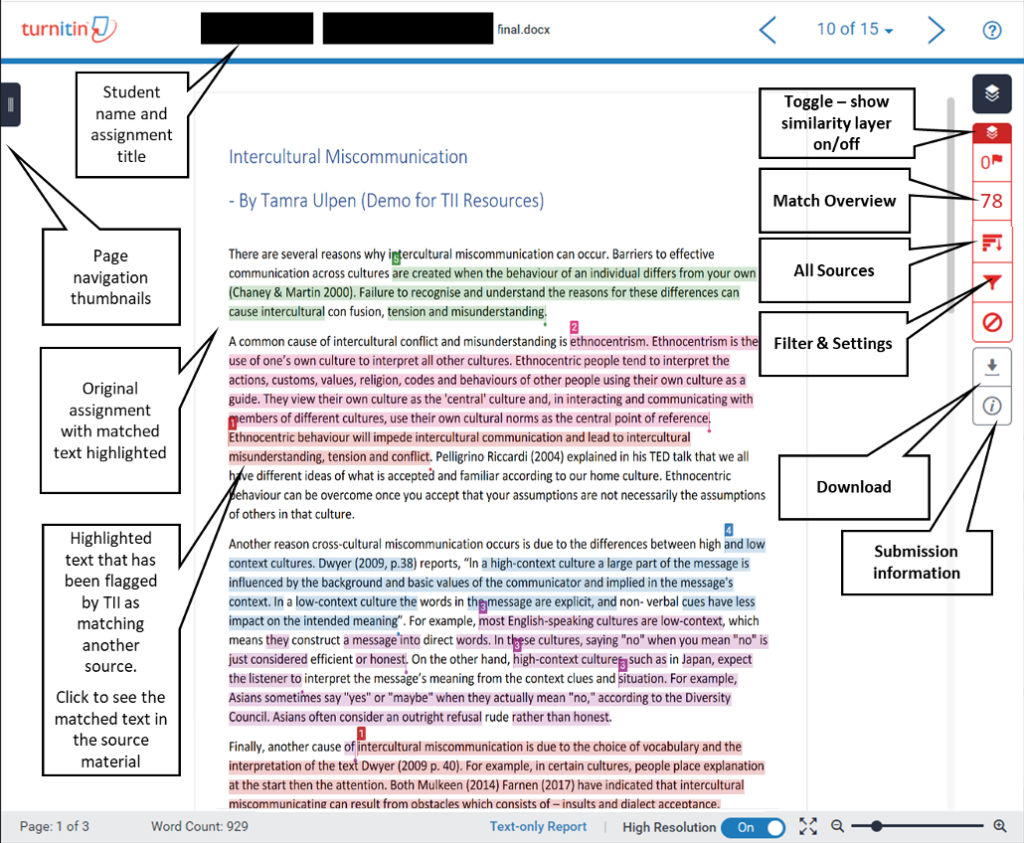
Your first move is to request the complete AI Writing Report from your instructor. This report includes the overall percentage, the interactive submission breakdown, and color-coded highlights showing exactly which sections triggered the flag. Cyan highlights indicate text flagged as AI-generated. Purple highlights indicate text flagged as AI-generated but modified with a paraphrasing tool. If your score shows an asterisk, like *%, it means the detection falls below the 20% threshold and Turnitin considers it less reliable.
After any Turnitin score check, review the flagged sections carefully. Read them aloud. Do they sound like your writing? Often, the highlighted passages are the most formal or structured parts of your paper, such as literature reviews, methodology sections, or definitions. Identifying why the algorithm flagged specific passages helps you explain your authorship later.
Step 2: Gather Evidence of Your Writing Process
This is where you build your defense. Documentation is your best weapon against a false positive. The more evidence you have of your actual writing process, the harder it becomes for anyone to dismiss your claim.
Start with your version history. If you wrote in Google Docs, export the full version history. It shows every edit, every deletion, every addition, with timestamps. If you used Microsoft Word with Track Changes enabled, compile those revisions. If you wrote in a text editor without history, check if your operating system saved previous versions or if your cloud backup service has file snapshots.
Next, collect your drafts. Do not stop at the final version. Your rough draft, your outline, your brainstorming notes, your research materials. Screenshots of your browser history showing when you accessed sources. Photos of handwritten notes. Annotated PDFs with your highlights and comments. Your Zotero or EndNote library. Anything that shows a paper trail from idea to finished product.
Also gather samples of your prior writing. If you have previous essays from the same course or instructor, they can help establish that your voice, vocabulary, and sentence structure are consistent. This is especially powerful if your prior work was not flagged.
Step 3: Compare Flagged Sections to Your Drafts
Once you have the AI report and your documentation, put them side by side. Look at each cyan or purple highlight and trace it back to your earliest draft. Can you show that the flagged passage evolved through multiple revisions? Can you point to specific sources that influenced your phrasing? Can you explain why you chose particular words or structures?
For example, if Turnitin flagged your literature review, explain that you synthesized multiple peer-reviewed sources using the disciplinary conventions your professor taught. If it flagged your methodology section, note that you followed the IMRaD structure standard in your field. If it flagged a definition, explain that you paraphrased it carefully from a specific textbook and can show your notes.
The goal is not to prove that your writing is perfect. The goal is to prove that your writing is yours. That it has a history. That it came from a human brain working through ideas over time, not from a prompt entered into ChatGPT.
Step 4: Write a Clear, Professional Appeal
Now you need to communicate your case. A strong appeal letter is concise, evidence-based, and professional. It is not a rant. It is not an attack on Turnitin or your professor. It is a factual presentation of your writing process.
Start with a clear subject line: “Appeal of AI Detection Flag – [Your Name] – [Course Number].” Open by acknowledging the AI report and stating your position: you wrote the work yourself and believe the flag is a false positive. Then systematically present your evidence. Describe your research process. Explain your drafting timeline. Reference specific attachments, like your version history or prior essays. Quote Turnitin’s own guidance that scores should not be used as the sole basis for adverse actions.
Request a meeting to review the evidence together. Face-to-face conversations often resolve misunderstandings faster than email chains. If your institution has a formal appeals process, follow it precisely. Submit through the proper channels, keep copies of everything, and document your timeline.
Throughout, maintain a collaborative tone. Your professor is not your enemy. They are a professional who wants to uphold academic integrity, and your job is to show them that integrity is exactly what you demonstrated.
Step 5: Know Your Institutional Rights and Processes
Every university handles AI flags differently. Some instructors treat them as conversation starters. Others treat them as automatic triggers for academic integrity investigations. You need to know which category your institution falls into.
Check your student handbook for the formal appeals process. Most schools have a specific timeline, often 10 to 14 days, to submit a written appeal. Some cases go to an academic integrity office or faculty panel. Others can be resolved informally with a meeting and revised submission.
If your case escalates, you have options. Consult a student ombudsperson or academic advisor. They can review your materials, advise you on process, and sometimes accompany you to hearings. If you face a formal panel, bring printed copies of your evidence, stay concise, and answer questions directly. In many first-time or ambiguous cases, outcomes include educational remedies, like a revised submission or a citation workshop, rather than punitive measures.
One practical tip: if you believe the evidence is unclear after review, request that any record note that the accusation was based solely on the Turnitin score and that you do not accept the finding. This protects your record if the same issue happens again.
How to Prevent Future False Positives
Once you clear your name, you want to make sure this does not happen again. The best defense is a documented writing process combined with intentional stylistic choices that signal human authorship to detectors.
Write in stages and keep records. Use Google Docs or Word with Track Changes. Save intermediate drafts with clear filenames and dates. Take screenshots of your research. The more documentation you have, the stronger your position if another flag appears.
When drafting, vary your sentence length deliberately. Mix short sentences with longer ones. Use contractions occasionally. Add personal observations, specific examples from class discussions, or references to niche sources that an AI model would not know. Break up formal transition words with simpler connectors or none at all. Include a few sentences that are slightly messy or unexpected. Human writing is not perfectly uniform, and that irregularity is your friend.
If your school allows AI for brainstorming or outlining, disclose it. Transparency builds trust. If you use grammar checkers, mention it. If you collaborated with peers, clarify your contributions. The more upfront you are about your process, the less suspicious your final product looks.
When to Seek External Help
Sometimes an appeal stalls or a professor refuses to review the evidence. If you hit a wall, escalate. Contact your department chair, your academic dean, or your student affairs office. Bring your documentation and reference your institution’s own policies on academic integrity and due process.
You can also seek independent verification. Some students run their work through multiple AI detectors before submission to see if patterns trigger flags elsewhere. If Turnitin, GPTZero, and other tools all return low scores, that reduces the chance of a surprise high score from any single system. However, be cautious with free online tools. Many are inaccurate, and uploading your work to them can compromise your intellectual property or even breach academic integrity if the service stores and resells student papers.
If you need to revise flagged passages before resubmission, focus on changing the statistical patterns, rather than only swapping synonyms. Restructure sentences. Add your own analysis. Insert specific details. The goal is to make the text less predictable and more varied, which is what human writing naturally does.
Understanding the similarity score
Key Takeaways
A Turnitin AI flag on work you wrote yourself is frustrating, but it is manageable. If you are dealing with a high AI percentage or an unexpected Turnitin similarity result, the process is the same. The algorithm looks for statistical patterns, not proof of misconduct. False positives are well-documented, especially for non-native speakers, technical writers, and students who edit their work thoroughly. Your best response is calm, documented, and evidence-based.
Request the full report. Gather your drafts and version history. Compare flagged sections to your process notes. Write a professional appeal. Know your institutional rights. And going forward, document your process and vary your writing style to make your human authorship unmistakable.
Turnitin is a tool, not a judge. Your professor is a professional, not an adversary. Approach the situation with facts, not fear, and you give yourself the best chance at a fair resolution.