

Learn how Turnitin works in 2026. Understand AI detection, similarity reports, perplexity, burstiness, and what your scores mean.
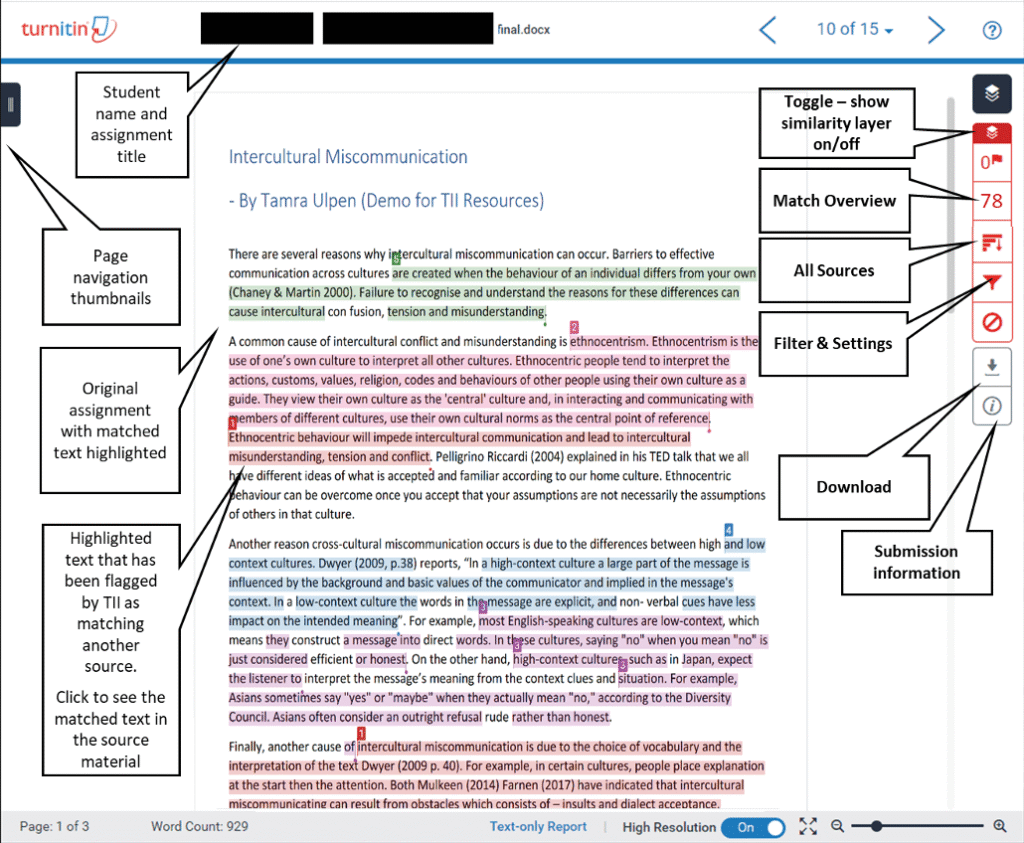
When you upload your essay to Turnitin, you probably think you are running a simple Turnitin check for copied text. In 2026, that assumption is about half right. Turnitin now runs two completely separate analyses on every submission. One hunts for matching text in its massive database. The other scans for the statistical fingerprints of AI writing tools like ChatGPT, Claude, and Gemini. These two systems do not talk to each other. A paper can score 0% on similarity and still get flagged for AI content, or it can show high similarity with zero AI suspicion.
Over 16,000 institutions and 2.2 million instructors now use Turnitin globally . If you are a student, researcher, or academic writer, you need to know how both systems work. Not so you can trick them, but so you understand what the numbers actually mean when they appear on your screen.
What Turnitin Actually Checks
Turnitin is not technically a plagiarism detector. It produces a Similarity Report, not a plagiarism verdict . The difference matters. Plagiarism is a human judgment about intent. Turnitin simply finds text that matches something already in its database. It is your professor who decides if that match counts as cheating.
In 2026, every submission triggers two independent reports:
- Similarity Report: Compares your text against billions of web pages, academic journals, books, and previously submitted student papers. It calculates a percentage of matching text.
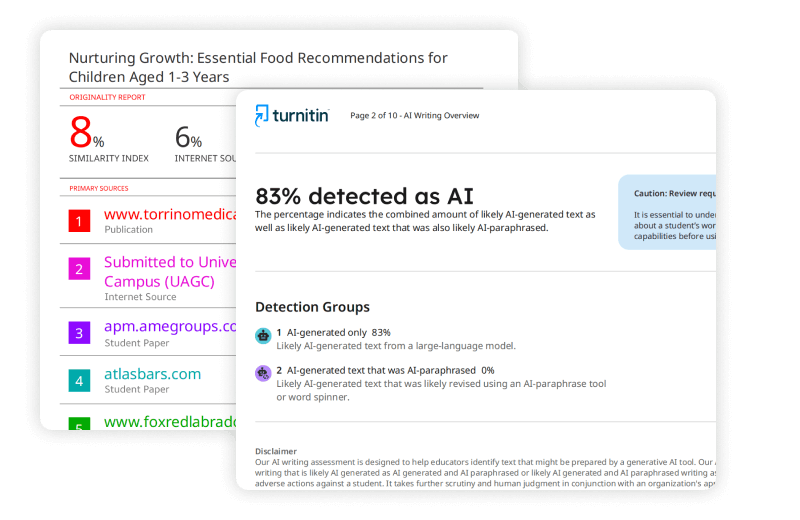
- AI Writing Report: Analyzes sentence structure, word choice predictability, and writing rhythm to estimate how much of your text was generated by AI.
These scores are independent. You can have 0% similarity and 80% AI detection, or 30% similarity with no AI flag at all . Understanding this separation is the first step to interpreting your results correctly.
How the Similarity Report Works
Turnitin’s similarity database includes current and archived web pages, academic publications from major publishers, and a vast repository of student papers submitted over decades . When you run a Turnitin check, the system breaks your document into small text strings and compares them against this database.
In early 2026, Turnitin rolled out its Enhanced Similarity Report as the default view for all users . The update reorganized how matches appear. Instead of a single list of overlapping sources, the report now groups matches into categories. This makes it faster for instructors to spot the difference between a properly cited quote and a copied paragraph without attribution.

Check before you submit. Get Turnitin Score Report in 15 Minutes.
Don't risk the 'Red' score. Get the exact same Turnitin report your supervisor uses. You will receive a full PDF similarity report including AI detection.
What the Similarity Percentage Actually Means
A 15% similarity score does not mean 15% of your paper is plagiarized. It means 15% of your text matches something in Turnitin’s database . That match could be:
- A properly cited direct quote
- Standard terminology in your field
- Common phrases like “in conclusion” or “on the other hand”
- Your bibliography or reference list
- Text from a source you cited correctly
Most universities do not enforce rigid similarity thresholds because context matters. A paper filled with block quotes from primary sources might show 40% similarity and be completely legitimate. A paper with 5% similarity might contain one uncited paragraph copied from a hidden source Turnitin cannot access .
Sources Turnitin Cannot See
Turnitin only catches what is in its database. It misses content behind paywalls it does not partner with, private repositories, unpublished manuscripts, books that have not been digitized, and content from private forums or messaging apps . This is not a loophole. Your professor might still recognize the source. Cite everything, even if Turnitin cannot find it.
How AI Detection Works in 2026
Turnitin’s AI writing detection launched in April 2023 and has received major updates through 2025 and 2026 . Unlike similarity checking, AI detection does not compare your text to existing documents. It looks for statistical patterns that large language models tend to produce.
Here is how the process works step by step:
Step 1: Segmentation
Turnitin splits your document into segments of roughly 300 words each . A 3,000-word essay becomes about 10 segments. Each segment gets analyzed on its own.
Step 2: Statistical Analysis
For each segment, Turnitin measures two key signals:
- Perplexity: This measures how predictable your word choices are. AI models select the statistically safest next word in a sentence. If Turnitin can easily guess what word comes next, your text has low perplexity, which signals AI authorship. Human writing is messier. We use unexpected words, change direction mid-sentence, and make choices that break statistical patterns .
- Burstiness: This measures variation in sentence length and structure. AI tends to write sentences in a narrow range, usually 15 to 20 words, with consistent rhythm. Human writing has bursts. We write a long, complex sentence followed by a short one. We vary our cadence .
Step 3: Classification
Each segment gets classified as either human-written or AI-generated based on these signals .
Step 4: Score Calculation
Turnitin calculates your final AI percentage by dividing the number of flagged segments by the total number of segments. If 3 out of 10 segments trigger as AI, your score is 30% .
Step 5: Flagging
The system highlights the specific segments it believes contain AI-generated text. Instructors see these highlights alongside the percentage score.
What Turnitin Catches Well
Turnitin’s AI detection performs best on unmodified AI text. If you copy output straight from ChatGPT, Claude, or Gemini without editing, the system identifies several telltale patterns:
- Uniform sentence length across paragraphs
- Predictable, safe word choices with low perplexity
- Repetitive transitions like “Furthermore,” “Moreover,” and “Additionally”
- Rigid paragraph structure where every section follows introduction-body-conclusion format
- Absence of personal voice, specific examples, or genuine opinion
According to Turnitin’s own reporting, the detector catches approximately 85% of unmodified AI text while keeping false positives below 1% for documents scoring above 20% . That accuracy drops significantly when students edit the output, add personal examples, or vary sentence structure.
Where Turnitin Struggles
No detection system is perfect. Turnitin has documented blind spots that matter for both students and instructors.
Lightly Edited AI Content
This is Turnitin’s biggest gap. When someone manually restructures sentences, adds personal anecdotes, varies tone, or mixes human-written sections with AI drafts, the accuracy drops noticeably . Turnitin’s Chief Product Officer Annie Chechitelli has publicly acknowledged that the system deliberately accepts missing up to 15% of AI-written text to keep false positive rates below 1% .
Non-Prose Formats
Turnitin’s AI model is built for long-form prose. It does not reliably detect AI-generated poetry, scripts, bullet-point lists, tables, annotated bibliographies, or short responses under 300 words . If your assignment mixes formats, the AI score only reflects the prose portions.
Translated Content
Turnitin’s AI detection currently supports English, Spanish, and Japanese . If you write in another language and translate to English using Google Translate or DeepL, the output often gets flagged as AI because translation tools function like large language models. They select statistically probable words, producing text with low perplexity and low burstiness .
False Positives
AI detectors sometimes flag genuine human writing. A 2023 Stanford study found that AI detectors classified over 61% of essays by non-native English speakers as AI-generated . The reason is simple. Non-native writers often use simpler vocabulary and more formulaic sentence structures, which overlap with the patterns detectors associate with machines.
Other groups affected by false positives include students in highly structured disciplines like science and law, neurodivergent writers who use repeated phrases, and students who write with unusual polish . Turnitin suppresses exact scores below 20% and shows only an asterisk specifically to reduce the impact of low-confidence predictions .
What Changed in 2026
Several updates have reshaped how Turnitin works this year.
Enhanced Similarity Report Becomes Default
As of March 2026, the Enhanced Similarity Report replaced the classic view as the default for all institutions . The new interface uses match categories to organize results, includes a flags panel for manipulated text like hidden characters, and offers improved accessibility aiming for full WCAG 2.0 and 2.1 AA compliance .
AI Scores in Authorship Reports
In January 2026, Turnitin added AI writing scores directly into Authorship Reports . Investigators and administrators can now view AI detection results alongside similarity scores without opening individual reports. This streamlines academic integrity investigations and helps institutions spot patterns of contract cheating or AI misuse across multiple submissions .
Expanded Language Support
Turnitin added Japanese to its AI detection capabilities in 2026, joining English and Spanish . The company has also signaled plans for broader multilingual coverage and better handling of regional dialects .
Multimodal Detection on the Horizon
Turnitin’s 2026 roadmap includes detection for speech-to-text submissions, image-to-text content, and AI-assisted code . These features are not yet fully deployed, but they signal where the platform is heading as AI tools expand beyond text generation.
How to Read Your Turnitin Check Results
When you get your Turnitin check results, focus on context, not percentages alone.
Similarity Score: Look at what is actually matching. Is it your reference list? Direct quotes you cited properly? Common phrases? Or is it a full paragraph with no quotation marks? The report shows you the specific sources and the exact matching text. Use that information.
AI Score: If your institution lets you see it, remember that Turnitin itself states its AI scores “should not be used as the sole basis for adverse actions against a student” . The score is a screening tool, not proof. If you wrote the paper yourself and got flagged, gather your drafts, notes, and version history. Request a meeting with your instructor to review the report together.
Practical Steps for Clean Submissions
If you want your paper to pass both checks without issues, focus on writing habits rather than trying to outsmart the algorithm.
Cite everything. Even sources Turnitin cannot access belong in your bibliography. Academic integrity is about honesty, not avoiding detection.
Paraphrase properly. Read the source, close it, and write the idea in your own words. Do not swap synonyms alone. Change the sentence structure and add your own analysis.
Vary your sentences. Mix short sentences with long ones. Break rhythm intentionally. Add personal examples or specific references from your course that an AI would not know.
Edit AI drafts heavily. If you use AI for brainstorming, treat the output as a rough draft. Rewrite every section in your own voice. Add your own reasoning. Insert references the AI cannot access.
Avoid translation shortcuts. If you must translate, edit the English output extensively. Inject your own vocabulary and sentence structure variations to break the statistical patterns translation tools produce .
Keep your drafts. Save every version of your paper. If a false positive occurs, your draft history serves as evidence of your writing process. Most universities have appeal processes, and documented drafts strengthen your case significantly.
Why This Matters for Your Academic Work
Turnitin is a tool, not a judge. It generates data points that require human interpretation . A high similarity score does not automatically mean plagiarism. A clean report does not guarantee originality. The most effective strategy is not to optimize for Turnitin’s algorithm. It is to develop genuine writing skills, cite your sources properly, and use tools responsibly.
At AnswersFountain, we help students and researchers understand their Turnitin check results before final submission. Our services include detailed similarity reports, AI detection analysis, and professional rewriting support when you need to clarify your original voice. We do not help you cheat. We help you present your best, most authentic academic work.
Understanding how Turnitin works in 2026 gives you control over your submissions. You stop fearing the numbers and start using them as feedback. That shift in mindset is what separates students who struggle with academic integrity policies from those who move through their programs with confidence.